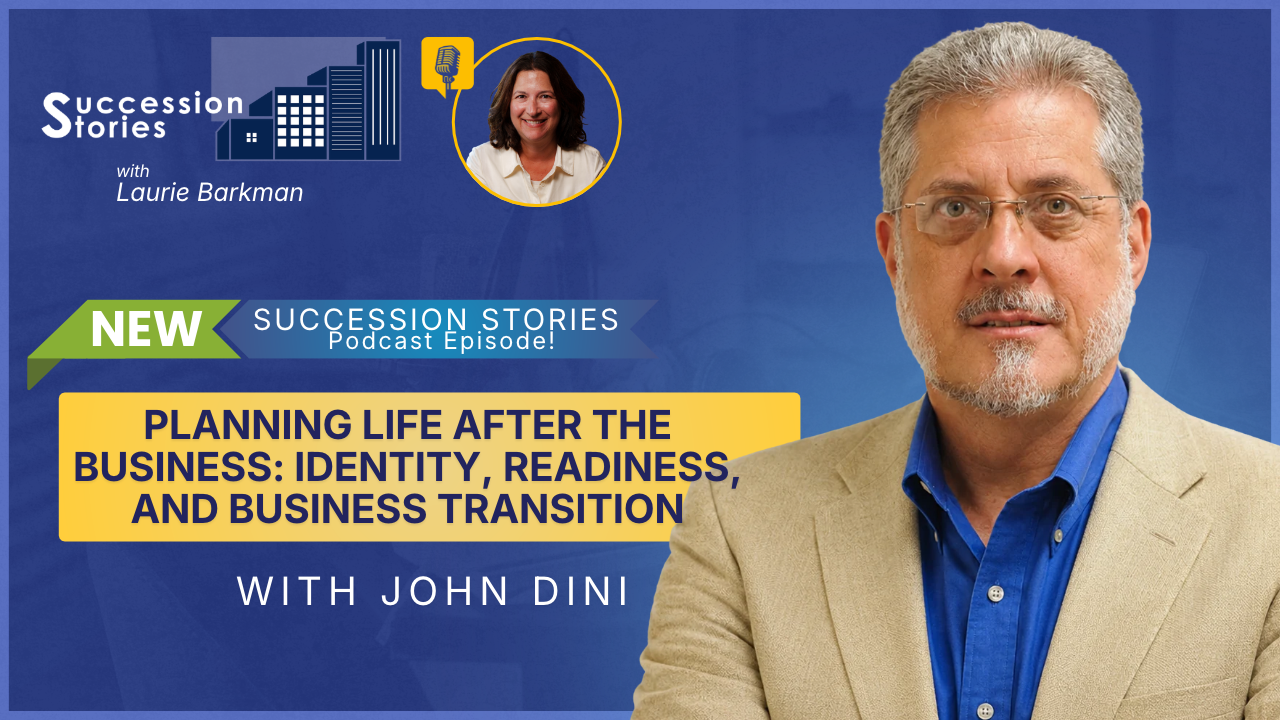
Succession Stories EP240: Planning Life After the Business: Identity, Readiness, and Business Transition, with John Dini
Why do so many business owners spend decades building a company and almost no time preparing to leave it? Having a successful business doesn’t automatically mean you’re ready for a successful transition. In this episode, host Laurie Barkman sits down with John Dini, founder and CEO of Exit Map, to talk about what he has learned as a serial entrepreneur, business broker, and certified exit planning advisor. They explore why the money is rarely the real problem, why owner identity shapes the entire process, and how a simple five-meeting framework helps owners turn goals into a plan.
A Successful Exit Doesn’t Begin With Finding a Buyer
Succession in Most business owners spend decades building something remarkable. And then, when it comes time to think about what happens next, they convince themselves they can figure it out on their own.
That, according to my guest in this episode of Succession Stories, is one of the most expensive mistakes a founder can make.
I sat down with John Dini, founder and CEO of ExitMap, a platform designed to help business owners and their advisors navigate the complex process of business transition. John has spent most of his career working with entrepreneurs, and what I appreciate most about his perspective is that he has lived both sides of this. He’s been the entrepreneur who built and sold, and he’s been the advisor in the room helping others do the same.
This conversation is honest, a little uncomfortable in the best possible way, and full of things worth hearing.
The Danger of Thinking You Know Everything
Business owners, by nature, know their businesses inside and out. They’ve made every decision, solved every problem, and worn every hat at some point along the way. That depth of knowledge is what made them successful. And it can also become a liability when it’s time to transition.
The belief that I know everything about my business therefore I know how to sell my business, John told me, is really dangerous. Transitioning a business requires a coordinated team. A lawyer. A tax expert. A valuation professional. A financial planner. And someone whose job is to make all of those people work together toward the same outcome.
He shared a story about a couple who were approached by a private equity group and thought they could manage the process themselves. John’s response was blunt. Every single step of that process is scripted. The PE group has done everything they’ve said to you a hundred times before. You’re bringing a knife to a gunfight.
You didn’t build your business by yourself. So why would you try to transition it by yourself?
The Money Is Not the Problem
Here is where John said something that I think deserves to be said louder and more often.
Seventy-five percent of business owners are unhappy a year after their exit. And it’s not because they didn’t get the money. John has never met an owner who signed a purchase agreement without knowing what number was on it. They know how much they’re getting. The problem is they don’t know what to do when the check clears.
He told me about an owner who sold his company and went out to lunch with a friend shortly after. When his friend introduced him to someone at the restaurant, he said, “This is Bob, he used to own ABC Corporation.” And Bob said his stomach sank. He realized he was facing the rest of his life being somebody that used to be somebody.
That is the transition nobody prepares for. Not the financial one. The identity one.
Wherever you go, business ownership comes with the same responsibilities. To their family, their employees, their vendors, their customers, their community. When that identity disappears overnight, without anything waiting on the other side, the result is not relief. It is loss. And the people closest to them often don’t see it coming either.
Why Owners Sabotage Their Own Deals
This part of our conversation hit close to home for me, having spent time on the M&A side of transactions.
Owners who don’t know where they’re going next make terrible clients. They drag their feet. They find more problems with the deal as time goes on. They meet with prospective buyers repeatedly and find something new to dislike each time. They don’t pull information together when they should.
And time kills deals.
What looks like indecision or disorganization is often something much more fundamental. It’s fear. The abject fear of not knowing what comes next. The business has been the answer to every question about identity, purpose, and structure for decades. When the sale closes, all of those answers disappear at once.
The owners who navigate this well are the ones who have figured out what comes next before the deal is done. Not after. And getting there requires asking some hard questions well in advance of any transaction.
The Question Every Advisor Should Be Asking
I asked John what one conversation he wishes every advisor would have with a business owner five, seven, or ten years before a potential transition.
His answer was immediate.
Tomorrow morning, you’re not coming into this business anymore. Tell me about your life.
Entrepreneurs are task-driven and goal-oriented. They always have something to look forward to, something to work toward. Without that, they won’t leave. And the ones who do leave without a plan are the ones checking their bank balance fifteen times a day, playing golf until they can’t stand it anymore, and quietly wondering what happened to the life they thought they were building toward.
John put it plainly. There are seven ways to leave your business, and six of them are head first. You will leave. The only question is whether you will have done the work to make that transition something you chose, rather than something that happened to you.
That question, what does your life look like without this business, is not a soft question. It is the most important question in the room. And it’s the one that most advisors are not asking nearly early enough.
Why This Matters
John also walked me through the five-meeting framework behind ExitMap, which he built after years of watching owners call him ready to sell when they were anything but. The structure covers everything from stakeholders and financial readiness to business readiness and personal identity, and it’s one of the most practical approaches to transition planning I’ve come across.
There’s also a story he told near the end of our conversation, about driving past a client’s business two years after their work together, that I think captures exactly why this work matters. I’ll let him tell it.
Listen to the full episode to hear John’s entrepreneurial journey, the ExitMap process, and the one thing he’d tell every owner who knows they need to plan but hasn’t taken the first step yet.
By your side,
Laurie Barkman
You can watch the full YouTube Episode here:
Connect with Joh Dini:
Email: [email protected]
LinkedIn: https://www.linkedin.com/in/johnfdini
Website: https://www.johnfdini.com/