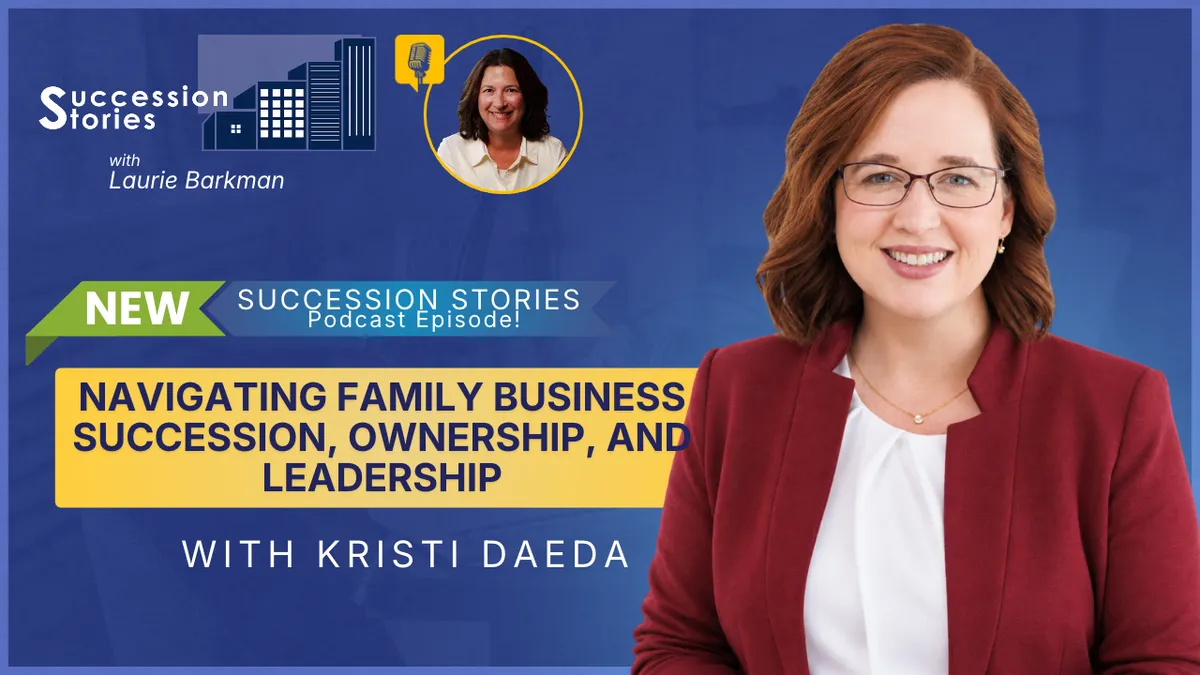
Succession Stories EP239: Navigating Family Business Succession, Ownership, and Leadership, with Kristi Daeda
What does it truly take to keep a family business thriving across generations? Succession is often framed as a simple handoff, but successful transitions require aligning owners, preparing leaders, preserving relationships, and sometimes rethinking what it means to be a family business. In this episode, host Laurie Barkman sits down with Kristi Daeda, President and CEO of the Family Business Consulting Group, to challenge common myths about family enterprises. They explore why leadership succession is more than just "passing the keys," how companies are successfully separating ownership from management by hiring outside non-family CEOs, and what business owners can do today to build a resilient future.
What Nobody Tells You About Passing the Baton in a Family Business
Succession in a family business is rarely what people imagine it to be. It’s not a moment. It’s not a handoff. And it’s almost never simple.
In this episode of Succession Stories, I sat down with Kristi Daeda, CEO of the Family Business Consulting Group, an organization that has spent over 30 years helping family-owned enterprises navigate the complexities of ownership, leadership, and generational transition. This conversation challenged some of the most deeply held assumptions about what succession actually requires, and I think it will stay with you long after you finish reading.
The Myth That Family Businesses Are Unsophisticated
Let’s start by busting something that comes up more than it should.
When people hear the words family business, they often picture a small mom-and-pop operation. The local pizza shop. The neighborhood hardware store. But family businesses make up the vast majority of our economy, and they span an enormous range, from early-stage startups where a couple is working the floor together to multi-billion dollar organizations leading entire industries.
Many of the families Kristi works with are deeply sophisticated in their planning, their governance structures, and how they operationalize what matters most to them as a family within the business. The stereotype, she told me, rarely holds up under scrutiny.
The Accidental Family Business
One of the ideas that struck me most in our conversation was the concept of the accidental family business.
Not every founder sets out to build a family enterprise. Many build something remarkable, and then at some point, often when their kids become teenagers, they start wondering whether the business could become an opportunity for the next generation. It happens step by step, one decision at a time, until one day they look around and realize they have become a family business without ever quite intending to.
What’s changing now, Kristi noted, is that more families are separating ownership from leadership. A recent study her firm conducted with Plante Moran, a repeat of research done 30 years ago, found that while 75% of family businesses still intend for their successor to be a family member, 25% are actively exploring other options. They are bringing in professional non-family leaders while the family retains ownership.
That shift is significant. And it raises a whole new set of questions about what it means to be a good owner rather than simply a good operator.
Why Choosing a Successor Is Not Enough
This is where the conversation got really interesting for me.
There’s a common assumption that once you’ve identified the next leader, the hard part is over. Kristi pushed back on that directly. Choosing a successor is necessary. It is not sufficient.
For succession to work well, she said, you need the right leader for the right time, genuine trust in that person’s ability to lead, and everyone involved being truly ready to make the transition. That last part, everyone being ready, is where most succession processes quietly fall apart.
The outgoing leader is often holding on to something they can’t quite name. The incoming leader is trying to build credibility without undermining the trust the previous leader spent decades earning. And nobody is saying out loud what they’re actually feeling.
Kristi described it as onboarding and offboarding happening at the same time. I laughed when she said that, because I’ve lived that experience firsthand as an outside hire stepping into a CEO role in a third-generation family business. The dynamics are real and they are layered.
She also said something I want every founder to hear. The next leader is not supposed to look and act like the current one. The business is usually at a pivot point when succession occurs. What made the founder successful may not be what the business needs to thrive in its next chapter.
“Here Are the Keys. Don’t F It Up.”
I shared something with Kristi that I’ve heard more than once from guests on this show over the past six years. Some succession conversations have gone essentially like this. The outgoing leader hands over the keys and says, in so many words, don’t mess it up.
That’s not empowerment. That’s a constraint masquerading as a handoff.
When the next leader feels that kind of pressure, they don’t take risks. They don’t innovate. They maintain the status quo because anything different might be seen as the moment things went wrong on their watch. And given that Kristi’s research found remarkable consistency over 30 years, with family businesses largely staying the course, that dynamic may be more common than we want to admit.
But the world is not staying the course. AI alone is reshaping entire industries. The families that thrive, Kristi told me, are the ones that learn to hold tradition and change at the same time. Not one or the other. Both.
The Role of Governance in Getting It Right
One of the most practical parts of our conversation was about boards and governance structures. Many founders don’t feel the need for a formal board. They’ve built the company themselves. They have advisors they trust. A board can feel unnecessary or even threatening.
But Kristi made a compelling case for why a board becomes especially important at the moment of succession. It gives the outgoing leader a concrete, meaningful role as board chair. It creates oversight that doesn’t depend on a parent-child dynamic. And it gives the incoming leader room to lead without constantly feeling the previous generation looking over their shoulder.
The board question connects to a broader point about role clarity. One of the most disorienting aspects of succession for a departing leader is the loss of the CEO identity. What is my role now? What decisions are still mine to make? A well-defined governance structure can answer those questions in a way that preserves dignity and usefulness without undermining the new leader’s authority.
What the Research Revealed and Why It Should Concern Us
Kristi shared something from their study that I haven’t been able to stop thinking about.
Families today are more sophisticated in their planning than they were 30 years ago. More of them have estate plans, buy-sell agreements, and strategic plans in place. That sounds like progress, and in some ways it is.
But families also understand those plans less than they did 30 years ago.
We have accelerated our documentation without deepening our comprehension. And that gap creates real risk. A plan nobody fully understands is a plan that may not hold when it matters most. It can create confusion, conflict, and decisions that inadvertently put the larger enterprise at risk.
The antidote, according to Kristi, is ongoing conversation. Not one big meeting where the plan gets explained and then filed away. Regular, intentional discussions where families revisit their plans together, surface questions they don’t yet know how to answer, and make sure new family members coming into ownership roles actually understand what they’re inheriting.
Preparing the Next Generation, Even the Ones Not in the Business
Something I find myself talking about with clients more and more is what to do with family members who are talented, engaged, and genuinely want to be involved, but who aren’t working in the business and may never want to.
Kristi had a lot of practical wisdom here. Start early. Tell stories about the business from the time children are young, including the failures and the hard moments, not just the victories. Create structured ways for family members to stay connected, whether through a family council, philanthropy, involvement in new acquisitions, or simply by planning regular retreats where family and management come together.
The goal is to cultivate what she called emotional ownership alongside financial ownership. The family member who feels genuinely connected to the history and mission of the enterprise is a very different kind of owner than the one who simply holds equity.
Kristi’s Own Succession Story
What made this conversation particularly meaningful for me is that Kristi has lived succession from the successor side. She joined the Family Business Consulting Group in 2013, worked alongside the previous managing partner for seven years, went through a formal selection process, and eventually stepped into the CEO role.
She was candid about how challenging it is to sit in the successor seat. The scrutiny is real. The timeline can feel uncertain. What helped her most, she said, was knowing there was a process in place and being kept informed at every step along the way.
The firm ended up compressing the timeline rather than extending it. At a certain point, she and her predecessor looked at each other and realized the transition had already happened in every meaningful way. The formal handoff was simply catching up to reality.
That, to me, is what good succession looks like.
A Final Thought
If I had to distill everything Kristi shared into the two things that matter most, she actually did it herself at the end of our conversation.
Start earlier than you think you need to. And put the hard conversations on the table.
Those two things, done consistently and with intention, give a family business the best possible chance of navigating whatever comes next. Not because succession becomes easy. But because the people involved have done enough of the hard work ahead of time that they are ready when the moment arrives.
This was one of those conversations I’ll be pointing clients to for a long time. Listen to the full episode to hear Kristi share the research findings, her own succession story, and the nuances that simply can’t be captured in a summary.
Sign up for my newsletter for more reflections and insights on succession, transition, and building with your end game in mind. lauriebarkman.me/newsletter
By your side,
Laurie Barkman
You can watch the full YouTube Episode here:
Connect with Kristi Daeda:
Email: [email protected]
LinkedIn: https://www.linkedin.com/in/kristidaeda/
Website: https://www.thefbcg.com/