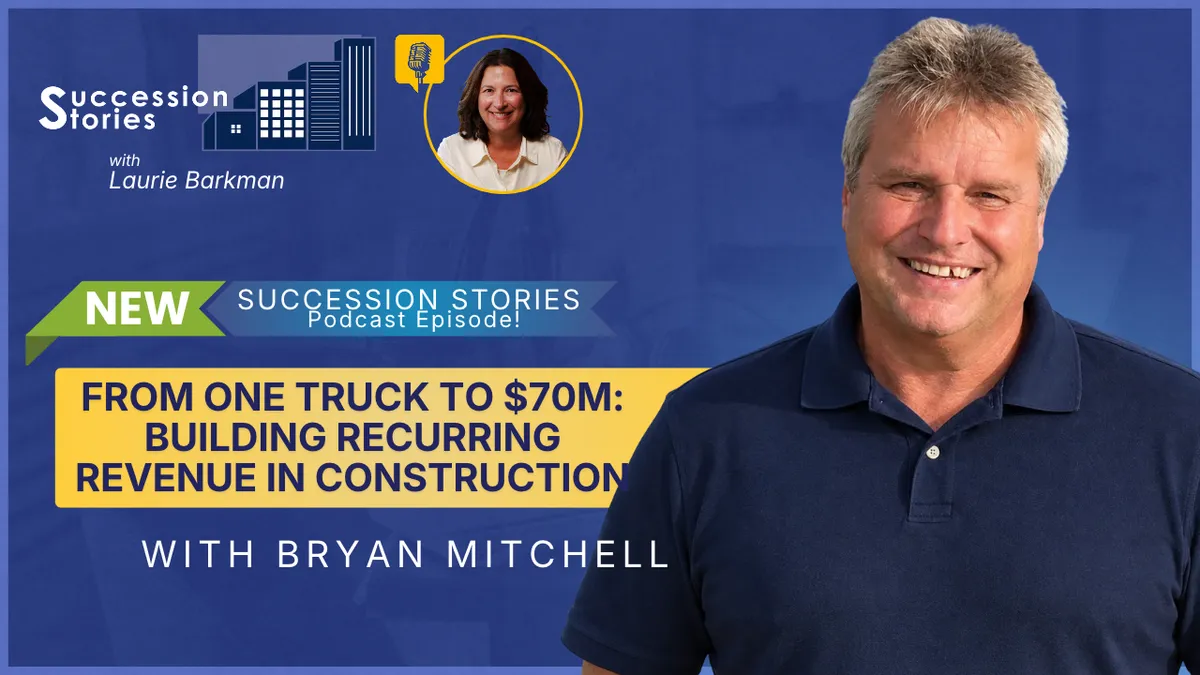
Succession Stories EP238: From One Truck to $70M: Building Recurring Revenue in Construction, with Bryan Mitchell
“If you’d like to begin the year with $3 to $5 million in revenue already for you to do, then you should be investigating this.” Bryan Mitchell helped transform a struggling commercial roofing company into a $70M business by building something the industry said couldn’t be done: meaningful recurring revenue in a project-based business.
The Recurring Revenue Opportunity Most Contractors Overlook
What if your next growth opportunity isn’t winning another project, but keeping the customers you already have?
In this episode of Succession Stories, I spoke with Bryan Mitchell, a longtime commercial roofing executive who helped transform a struggling roofing company by building a service and maintenance business alongside its project work.
The result? One service truck grew to 32, generating approximately $14 million in revenue. The company eventually reached nearly $70 million.
Bryan challenged a common belief in construction: recurring revenue doesn’t work. His experience tells a different story.
Stop Waiting for the Next Big Project
When the banking crisis of the early 2000s slowed re-roofing projects, Bryan knew the business needed another way to generate revenue.
His answer was service and maintenance.
Consider your car. You change the oil to prevent a breakdown. Yet many building owners ignore their roofs until a leak forces them to act.
Bryan saw an opportunity to change that.
Research from the National Roofing Contractors Association suggests that a low-slope roof may last around 15 years without maintenance, 20 with occasional maintenance, and 30–35 under a managed maintenance program.
For a building owner facing a potential $500,000 replacement, that’s a compelling reason to plan ahead.
Maintenance isn’t just about fixing problems. It’s about preventing expensive ones.
The lesson is simple: don’t just sell the repair. Show customers the value of preventing the problem in the first place.
Relationships Beat the Race to the Lowest Price
Bryan knew the team couldn’t build a maintenance business by simply waiting for the phone to ring. They needed to reach decision-makers before a problem arose.
So they got creative.
The team used aerial roof assessments and mailed personalized cartoon postcards to prospects every month. One executive had 12 of those postcards framed on his office wall.
That’s memorable marketing.
The lesson? Consistency builds familiarity, and familiarity can open doors long before a customer is ready to buy.
Bryan also stressed the importance of meeting the decision-maker before conducting an inspection. The goal was to understand the customer’s needs and demonstrate value, not just respond to a leak.
Build a Business That Can Scale
Recurring revenue doesn’t happen simply because you offer a maintenance plan. You need a process your team can repeat.
Bryan invested in training, sales, and systems that helped the business grow beyond the founder’s personal involvement. His team learned to explain the value of maintenance, prioritize customer needs, and identify issues before they became emergencies.
That last point matters. Bryan believes emergency work should account for less than 15% of a service business. The goal is to prevent crises, not build the business around them.
A strong maintenance program also helps contractors manage seasonal slowdowns and keep crews productive when new projects are harder to secure.
Recurring Revenue Builds More Than Revenue
Here’s where the strategy becomes especially powerful.
Maintenance keeps contractors close to customers and helps identify future re-roofing opportunities. Bryan recalled that the company’s core project business generated five or six times the revenue of its service operation.
The service business wasn’t replacing the core business. It was feeding it.
Bryan also shared an example of a Texas contractor who reportedly sold at a multiple roughly three times that of peers, attributing the difference to its service business. While no model guarantees a higher valuation, predictable revenue and durable customer relationships can make a business more attractive to buyers.
His recommendation: aim to have roughly 25% of clients enrolled in ongoing maintenance programs.
A Final Thought
Bryan’s story is a reminder that growth isn’t always about chasing the next big contract. Sometimes, it’s about creating a better reason for customers to stay.
A recurring service model can strengthen relationships, smooth out revenue, and create opportunities for larger projects down the road. It can also help build a more transferable business—one that isn’t constantly dependent on the next sale.
Bryan’s advice is simple: make the process repeatable, make the value clear, and keep investing in growth.
Those principles apply well beyond roofing.
Ask yourself: What could your business offer today that would keep customers coming back tomorrow?
Listen to the full episode of Succession Stories to hear Bryan’s lessons on building recurring revenue in a project-driven industry.
Sign up for my newsletter for more reflections and insights on succession, transition, and building with your end game in mindlauriebarkman.me/newsletter.
By your side,
Laurie Barkman
You can watch the full YouTube Episode here:
Connect with Bryan Mitchell:
Email: [email protected]
LinkedIn: https://www.linkedin.com/in/bryan-mitchell-850bb985
Website: https://serviceadvantedge.net