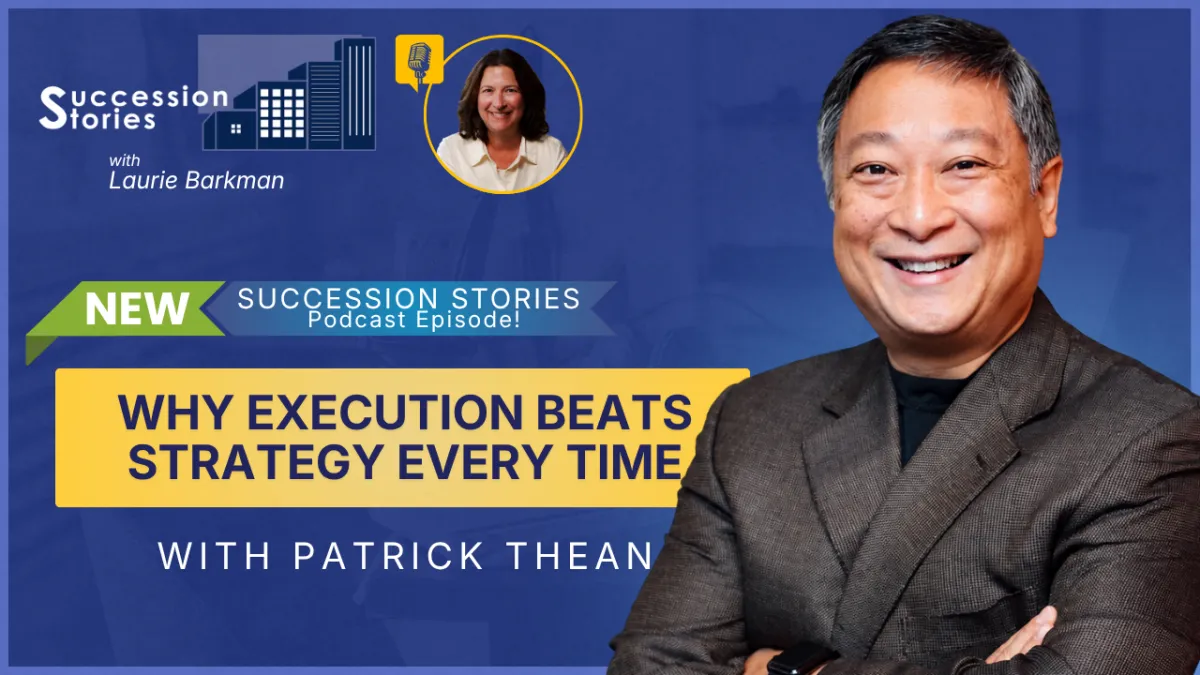
Succession Stories EP235: Why Execution Beats Strategy Every Time with Patrick Thean
"You are the leadership lid of your company. If you don't grow yourself, you will top out the growth of the company." Patrick Thean built a supply chain software company from zero to $25 million in seven years, landed at #51 on the Inc. 500, sold it at 32 — and woke up the next morning not knowing who he was. What followed was one of the most honest accounts of founder identity, burnout, and reinvention ever shared on this show. And the framework he built from all of it has since helped thousands of CEOs turn strategy into disciplined execution. Here's what he learned the hard way — so you don't have to.
Why Most Companies Don't Fail From Bad Strategy
What if the thing that's going to derail your exit isn't the market, the economy, or even a bad deal?
What if it's the gap between what you planned and what you actually executed?
In this episode of Succession Stories, I sat down with Patrick Thean, co-founder of Rhythm Systems, a man who has built and exited multiple companies, coached CEOs around the world, and spent two decades helping founders build businesses that can grow and eventually thrive without them.
This conversation is packed with hard-won lessons. And a few of them surprised even me.
The Founder Who Felt Like He Was Failing at the Height of His Success
Patrick's first company, a supply chain software firm called Metasys, grew from zero to $25 million in revenue in seven years. They were number 151 on the Inc. 500. By every external measure, they were winning.
On the inside, Patrick felt like they were failing.
Customers were unhappy with certain things. Problems kept surfacing. He was muscling through everything, working himself to the bone, burning the candle at both ends and in the middle, as he put it. His dad kept telling him to slow down. He kept laughing it off.
He sold the company at 33. And when it was over, he didn't feel victorious.
He felt relieved.
That distinction matters more than most founders want to admit. Relief at the finish line is often a signal that something about the journey wasn't sustainable. And for Patrick, that signal pointed directly to one thing. He had never learned to separate his identity from his company.
When the sale closed, he told his wife he felt useless because he didn't know if he could still program. She looked at him like he'd lost his mind. And in a way, he had. Not literally, but that comment, ‘I don't know if I can program anymore,’ wasn't really about programming. It was a man who suddenly didn't know who he was without his business.
That moment is more common than we talk about. And it's one of the reasons I do the work I do.
The Question That Changed Everything
After his second exit, a dot-com that survived the bubble but never captured his passion, Patrick sat down with a friend who asked him a simple question.
The friend stopped him mid-sentence and said: you didn't answer my question. I asked what you would like to do. You gave me a list of things you know how to do.
That's the moment Patrick found his calling. Helping CEOs avoid being blindsided by surprises that could cost them their companies. Twenty years later, he's still doing it because it's what he loves.
The lesson here isn't just about Patrick. It's about every founder who gets so busy building that they never stop to ask what they actually want. That question, what would you like to do, not what can you do, is one of the most important questions in transition planning. And most owners never hear it until it's too late to answer thoughtfully.
Strategy Is the Easy Part
One of the core messages Patrick brings to every CEO conversation is this.
Most companies don't fail because of bad strategy. They fail because of poor execution.
Strategy, he says, is fun. You sit in a room, you dream, you whiteboard, you get inspired. The hard work hasn't started yet.
Execution is where commitments break down. It's where the 5 PM workout gets replaced by the million dollar client call. It's where the quarterly priority gets buried under the daily urgency. It's where the distance between deciding and doing becomes a chasm that nobody talks about.
The fix, according to Patrick, isn't more willpower. It's commitment combined with the right rhythm of accountability. And accountability, he's quick to point out, isn't about consequences. It's about setting someone up to succeed before they fall short, not showing up after the fact to penalize them for it.
If your leadership team dreads accountability conversations, that's a sign the whole philosophy needs to shift.
The Fish Rots From the Head
Patrick doesn't shy away from the uncomfortable conversations. When he works with a CEO who thinks the problem lives in the team, his first move is to hold up a mirror.
He asks: what part of this movie did you play?
It’s not about asking: what did you do wrong? Whose fault is it?
He simply asks: what was your part in this?
That reframe, gentle but direct, opens a door that blame never could. Because the truth is, almost every organizational struggle has some fingerprints from the top. The leader who won't delegate. The founder who keeps bridging gaps that the team should be closing. The CEO who mistakes busyness for leadership.
Patrick's point isn't that leaders are the problem. It's that they're always part of the movie. And if they're not willing to examine their own role, they've forfeited the right to ask their people to examine theirs.
The Business That Can Run Without You
When I asked Patrick what he would tell every founder who's five years away from transition, his answer was clear.
Build a machine.
He told me about a friend who sold his company with one very specific wish. He didn't want to stay. Not because he was burned out, but because he had built something that genuinely didn't need him. He had a president who could run everything. The right buyer walked in, looked around, and said, we don't need you from day one.
The founder left the day the transaction closed.
That's not luck. That's years of intentional work to decentralize, to develop people, to document what was in his head, and to create a business whose value lived in the system, not the person.
That's what transferable value actually looks like. And it doesn't happen by accident.
The Habit That Makes Better Leaders
Patrick closed with something I want every founder to hear.
He believes the single most powerful thing a leader can do to grow is reflect. Daily if possible. Weekly at minimum.
Not just on what went wrong. On what went right too. What did you learn? What could you have handled better? What should you repeat? What are your top two or three priorities for tomorrow?
Self-awareness, he says, is like a muscle. You don't build it overnight. You build it rep by rep, week by week, in the quiet moments when you're honest with yourself about the kind of leader you actually are versus the one you want to be.
That practice, more than any strategy or system, is what separates the founders who transition well from the ones who don't.
Before You Go: A Conversation You Don't Want to Miss
For the advisors in my audience, this episode is a good reminder of how differently business owners think about their companies compared to how most wealth conversations are structured. Patrick's story alone, the identity crisis after the sale, the passion he was chasing, the machine he eventually helped others build, is the kind of context that changes how you show up for a client.
If you want to go deeper on that, I'm hosting a live webinar on August 12th at 12:00 PM ET with Michael Laliberté called The Missing Conversation in Business Owner Wealth Planning. It's designed specifically for advisors who want to start where their clients actually are, with the business, not the portfolio.
Reserve your spot here. Can't attend live? Register and be among the first to get the replay.
A Final Thought
What I loved most about this conversation with Patrick is his refusal to separate the personal from the professional. The identity crisis after his first exit. The passion he was chasing after his second. The calling he finally found when someone asked him the right question.
Those aren't footnotes to his business story. They are his business story.
And I think for most founders, the same is true. The business and the person inside it are inseparable. Which is exactly why the transition plan has to account for both.
Listen to the full episode to hear Patrick's frameworks, his stories, and the question he asks every CEO that almost always leads to a breakthrough.
By your side,
Laurie Barkman
You can watch the full YouTube Episode here:
Connect with Alan Bennett:
Website: https://www.rhythmsystems.com/
Email: [email protected]
LinkedIn: https://www.linkedin.com/in/patrickthean/