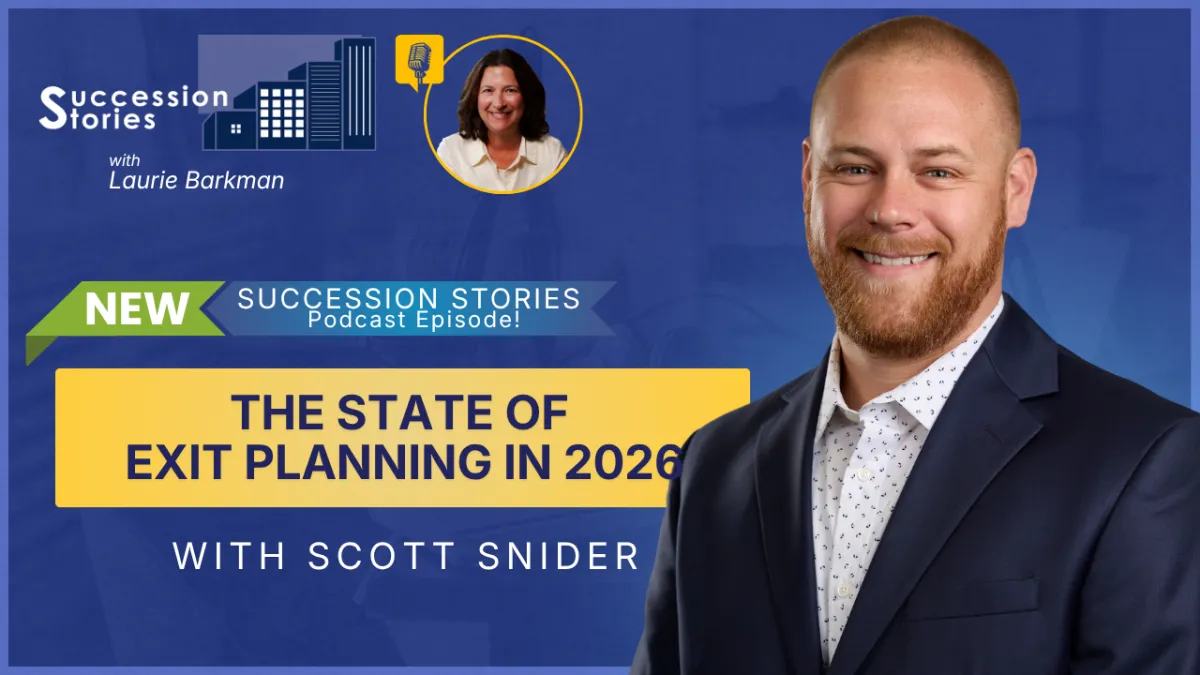
Succession Stories EP234: The State of Exit Planning in 2026 with Scott Snider
"A successful exit isn't about leaving your business. It's about leaving the world a better place after you leave it." Host Laurie Barkman welcomes back Scott Snider, President of the Exit Planning Institute — the organization behind the Certified Exit Planning Advisor designation and the Value Acceleration Methodology — for a return conversation four years in the making.
Four Years Later: What's Changed in Exit Planning and What Still Needs to
Some conversations are worth revisiting. This is one of them.
Four years ago, I sat down with Scott Snider, president of the Exit Planning Institute, for what became one of the most listened to episodes of Succession Stories. We talked about building a business that's independent of its owner and why the best exit strategy begins long before you plan to leave.
A lot has changed since then (you can watch the full episode here). Scott has grown EPI from 12 employees to 56, from 3,000 CEPAs to 11,000. The profession has matured. And the conversation around what a successful exit actually looks like has deepened in ways I find genuinely exciting.
So I invited him back. And this time, we went further.
Taking the Baton and What He Did With It
When Scott and I last spoke, he was preparing to step fully into the leadership role at EPI, succeeding his father Chris, who built the methodology that underpins everything the organization teaches.
I asked him what he did first once he had the baton.
His answer wasn't about strategy or growth targets. It was about culture.
He spent the first two years focused on people, structure, and building a workplace that the team actually wanted to be part of. The core values that had been on the wall came down. New ones went up, ones created by the entire organization, not handed down from the top.
What struck me about this is how closely it mirrors what I tell my own clients. Before you can build a business that's transferable, you have to build one that's genuinely healthy from the inside out.
Scott did exactly that. And the growth followed.
Leading With Grace and Love
One of the most honest moments in our conversation came when I asked Scott what surprised him most about himself as a leader.
He paused before answering.
He said he didn't know he was capable of leading with grace and love. Coming from a background in landscape construction, his default was militant and gritty. But the team he inherited at EPI, highly educated, purpose-driven, collaboration-oriented, needed something different.
So he changed.
That kind of self-awareness is rare. And I think it's one of the reasons EPI has grown the way it has under his leadership.
How the Conversation Around Exit Planning Has Evolved
This is where the conversation got really interesting for me.
When the Exit Planning Institute was founded in 2005, the framework was built around three legs of a stool: business, financial, and personal planning. The concept was right. But for a long time, the personal leg was the weakest. There was concept without content, framework without tools, and very few people actually doing the work.
What Scott shared about where things stand now is encouraging. At EPI's most recent summit, personal planning was one of the defining themes. There are now advisors who specialize in it. There are tools and processes built around it. The profession has moved from idea to implementation.
But here's what Scott also said, and I think this is the most important thing in the entire conversation.
Personal planning is still the weakest leg of the stool. Even now.
Owners are more educated than ever. They're more prepared than ever. And yet, when you look at the data, the deeper work around identity and purpose, around who you are with and without your business, is still being avoided, delayed, or written off as something to figure out later.
That's the can being kicked. And it's being kicked by some of the most successful business owners in the country.
Different Generations, Different Questions
One of the things I appreciated most about Scott's perspective is how clearly he sees the generational differences in how owners approach exit planning.
Baby boomers, now averaging 67 years old and owning 51% of privately held companies, are finally at the stage where the next chapter is coming into focus. For many of them, the business has been their identity for 40 or 50 years. What comes after is genuinely unknown territory.
Gen Xers, my generation, are thinking differently. Many want to exit earlier than their parents did. Not to disappear, but to make room for other parts of life they've been deferring. Family. Community. Purpose that isn't tied to a bottom line.
And the younger millennial founders? They're building with the exit in mind from day one. They've grown up with access to frameworks and advisors and conversations like this one. They're asking better questions earlier.
I see this in my own practice. My client in his 40s is focused on growth and value creation. My client in his 70s is under real pressure, navigating options that would have been much simpler a decade ago. Time changes everything.
Exit Strategy Is Business Strategy
Scott said something in this conversation that I want every business owner reading this to sit with.
Exit strategy is business strategy. There is absolutely nothing different.
Everything you do in your business today affects its value tomorrow. The question isn't whether you'll exit. The question is whether you'll be ready when that moment comes, or whether you'll be scrambling to catch up.
He also said something equally important. Business is personal. The business isn't separate from your life. It powers your lifestyle, your relationships, your sense of purpose, and your identity. And when it's gone, all of those things shift with it.
Those two ideas together, exit strategy as business strategy, and business as personal, are the foundation of everything I believe about this work.
What Needs to Happen Next
Exit planning as a profession has come a long way. But Scott is honest that it still isn't mainstream. There are 11,000 CEPAs today. The goal is 20,000. Even then, that's a fraction of what the certified financial planner designation represents.
What needs to happen is awareness. Owners need to know this kind of planning exists. And advisors need to move beyond just being technically credentialed to actually activating the conversation with clients.
That activation piece, the moment an owner goes from aware to engaged, is where Scott is focused for the next five years. And it's where I'm focused too.
A Final Thought
What I take away most from this conversation is a feeling of momentum.
The profession is maturing. The tools are better. The community is stronger. And more business owners than ever are starting to ask the right questions.
But the deeper work, the personal work, the identity work, the who am I outside of what I've built work, still has a long way to go. And I think that's where the most important conversations in this space need to happen next.
Scott and I are both committed to that. And I hope this conversation is one small push in that direction for whoever is listening.
Listen to the full episode to hear Scott's vision for the next five years of exit planning, the lightning round, and the open invitation I extended that I hope leads to one of the most meaningful episodes I've ever recorded.
By your side,
Laurie Barkman
Watch the full YouTube Episode here:
Connect with Scott Snider:
Website: https://exit-planning-institute.org/
LinkedIn: https://www.linkedin.com/in/scott-snider-epi