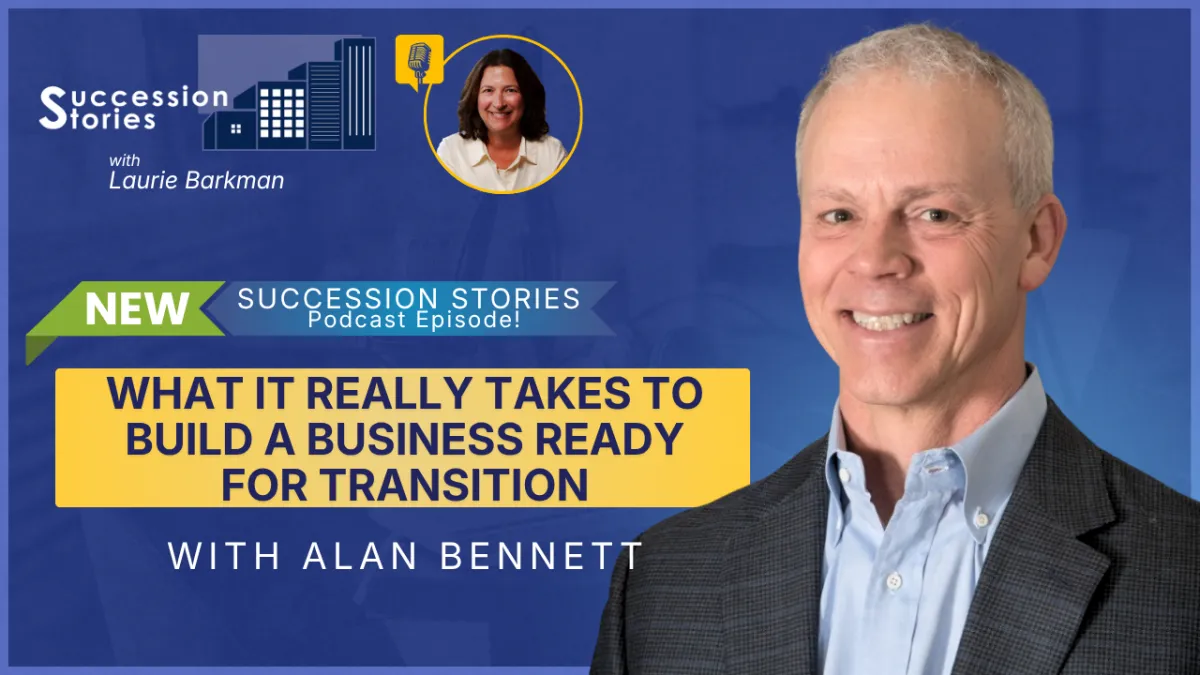
Succession Stories EP233: What It Really Takes to Build a Business Ready for Transition with Alan Bennett
"It's an exit plan, not an exit due." Host Laurie Barkman sits down with Alan Bennett, founder of Trust Built Solutions and exit planning coach who has lived through three very different business exits — a retail meat market that he closed in 2008, a contract catering business that a seller-financed deal and COVID unraveled in 2020, and a psychiatric practice exit to private equity where he finally got to use every lesson he had learned the hard way. Alan's story is one of the most honest and unfiltered accounts of what owner dependency really costs — not just in valuation, but in hours, health, relationships, and missed opportunities. He shares the trust cycle that unlocks delegation, the trap that keeps owners perpetually in the weeds, and why exit planning isn't about selling — it's about building a business that actually works without you.
Three Exits, Three Hard Lessons, and the Business He Almost Lost to a Pandemic
Some of the best lessons in business transition don't come from the wins. They come from the moments that didn't go according to plan.
In this episode of Succession Stories, I sat down with Alan Bennett, founder of Trust Built Solutions, and someone who has been through the full spectrum of what business ownership and exit can look like. Three businesses. Three very different outcomes. And a level of honesty about what went wrong that I don't hear often enough in this space.
This one stayed with me.
A Hundred Hours a Week and Nothing to Show For It
Alan's first business was a retail meat market in Little Rock, Arkansas. It grew organically into a catering operation. It crossed $2 million in revenue. And it consumed him completely.
At his peak, he was working 100 hours a week, seven days a week. Not because the business required it, but because he didn't know another way to run it. No systems. No processes. Just passion and push through.
When the lease came up in 2008, in the middle of a financial crisis, the landlord wanted a 10-year commitment. Alan had two young kids, a wife barely into her medical practice, and a customer base that was quietly disappearing. He closed the business.
What struck me most was what he said looking back. He didn't point the finger at the landlord, the economy, or the timing. He said simply: I put myself in that position.
That kind of self-awareness is rare. And it's the seed of everything that came after.
The Business He Built Right, and Lost Anyway
Four years later, Alan came back with a contract catering business serving private schools and summer camps. This time, things looked very different:
Recurring revenue through multi-year contracts
A team he trusted to run day-to-day operations
A schedule that had him working 25 to 30 hours a week in flip flops
In December 2019, he sold it to his chef through seller financing. The buyer made four payments. On time. And then the world shut down.
Every school closed. Every camp was canceled. The buyer walked away. Alan was left with hard assets worth pennies on the dollar and a deal that had no protective language for what had just happened.
He could have pursued legal action. He chose not to. The buyer was a single dad who had been loyal to him for 14 years. Alan liquidated what he could, absorbed the loss, and started asking harder questions about what he still didn't know.
The Third Exit, and Finally Getting It Right
The third exit was different. It was his wife's psychiatric practice, which private equity came calling on after it had grown from three to seven physicians.
This time, Alan brought everything he had learned. The preparation was more deliberate. The structure was more sophisticated. The outcome reflected it.
He's honest that it took significant work to get there. But that work is exactly what made the difference.
The Moment That Changed Everything
There's a story Alan told that I keep coming back to.
It was 2002. He was still deep in the meat market, still working those hundred-hour weeks. In the middle of the night, he drove back to the shop and started measuring steaks with a tape measure. He wanted every cut to be exactly an inch and a quarter.
His managers saw him on the security camera.
That was the moment they stopped trusting him.
Not because he had bad intentions. But because his actions sent a message he never meant to send. I don't trust you to do this right.
Alan built his entire business, Trust Built Solutions, around that moment. Because what he realized is that owner dependency isn't just a systems problem. It's a trust problem. And the trust that matters most isn't whether the owner trusts the team. It's whether the team trusts the owner.
Fix that, and everything else starts to move.
The Trap Most Owners Don't See Coming
One of the patterns Alan described that I see constantly in my own work is what he calls bridging the gap.
When two people on a team can't communicate effectively, the owner steps in and solves it. Every time they do, they teach the entire organization one thing: Alan will fix this. He always does.
It feels like leadership. It looks like responsibility. But it's a trap. And every time an owner steps into that gap, they make themselves harder to replace, harder to step back from, and harder to exit.
That codependency, between the owner and the business, is one of the most common value killers I see. And most owners are too close to it to recognize it.
As Alan put it: it's hard to read the label from inside the bottle.
What He Wants Every Business Owner to Know
Alan closed our conversation with something that I find myself saying to clients all the time, just in different words.
An exit plan is not an exit. It's preparation. And the best time to start is not when you're ready to sell. It's long before that moment ever arrives.
A few things he wants owners to hear:
Not planning ahead doesn't just cost you money. It costs you options.
Owner dependency is a value killer, and most owners can't see it from the inside.
Trust, once broken, can be rebuilt. But it has to be repaired the same way it was broken, consistently, over time.
Exit planning doesn't mean you're selling. It means you're building something worth selling, and worth keeping.
As Alan put it, it's hard to read the label from inside the bottle. That outside perspective isn't a luxury. It's often the difference between closing a business and transitioning one.
And as I say “Don't try to do exit planning when you're exiting, because it's just too late.”
A Final Thought
What I love about Alan's story is that it's not a highlight reel. It's the full picture, including the parts that didn't go according to plan, the parts that hurt, and the parts that required him to look in the mirror and take ownership of what went wrong.
That's not easy to do. And it's even harder to share publicly.
Those are the stories that matter most in this work. Because they're the ones that help other owners see themselves a little more clearly, and make better decisions while they still have the runway to do something about it.
Listen to the full episode to hear Alan tell it in his own words. I think you'll find something in it that hits close to home.
By your side,
Laurie
You can watch the full YouTube Episode here:
Connect with Alan Bennett:
Website: https://trustbuiltsolutions.com
Email: [email protected]
LinkedIn: https://www.linkedin.com/in/alanbennettcepa