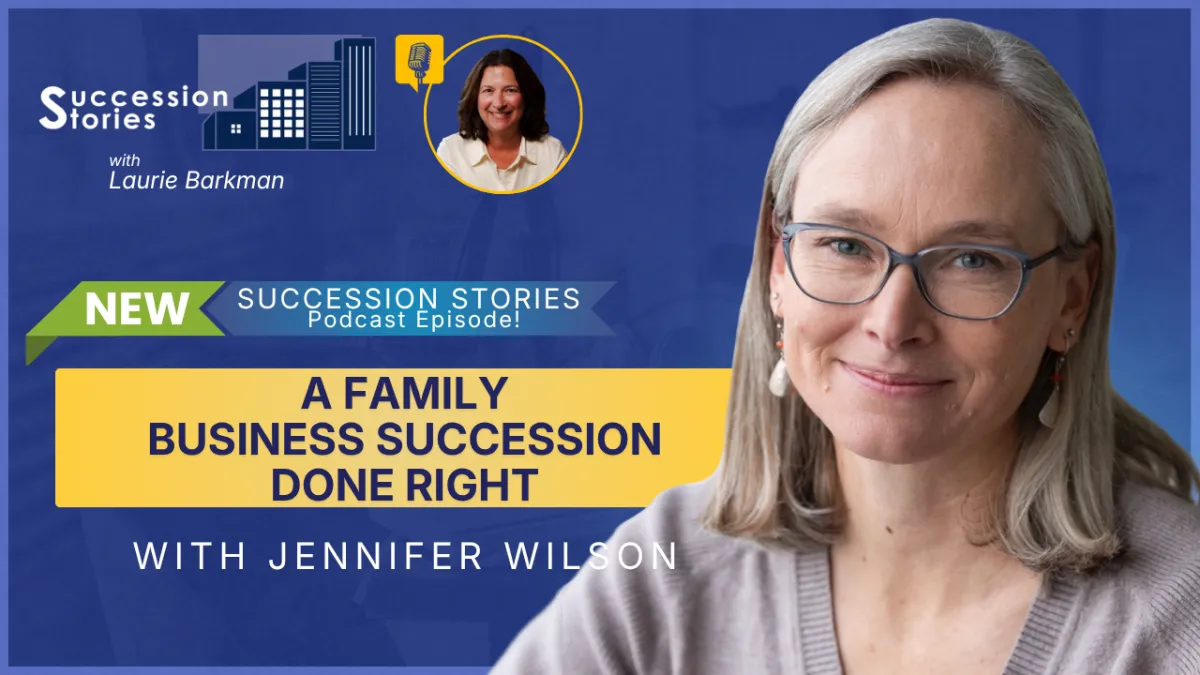
Succession Stories EP232: When the Founder's Daughter Becomes the CEO with Jennifer Wilson
Jennifer Wilson joined the company as an accidental second-generation leader, grew into the CEO role after completing her MBA, and spent 17 years building the organization before transitioning to chair in 2022.
She built a co-CEO structure, created a board of directors from scratch, and navigated a partial management buyout — all while keeping the family intact. Here's how she did it.
When the Founder's Daughter Becomes the CEO
What does succession really look like when it's your family's business, your parents are your employees, and the future of the company rests on decisions that affect everyone you love?
In this episode of Succession Stories, I sat down with Jennifer Wilson, founder of Oak Bay Coaching and Consulting, and former CEO of Canada Homestay Network, a family business her mother literally started out of their home in 1995. Jennifer spent 17 years growing CHN into an organization that places approximately 6,000 international students a year across Canada. And in 2022, she made the deliberate choice to step away.
What she built, how she left, and what she learned along the way is one of the most layered succession stories I've had the privilege of hearing.
It Started With a Recipe Box
Jennifer's mom didn't set out to build a company. She was running a bed and breakfast when a language school approached her about managing a homestay program. She said no. They called back. She said yes.
Thirty years later, CHN has placed over 100,000 students across Canada.
Jennifer joined the business in 2005, not because it was the plan, but because life handed her a moment where it made sense. A personal crisis, a vacancy in the company, two young children at home. What started as temporary became a calling she chose to lean into, deliberately and repeatedly, five years at a time.
When she stepped into the CEO role, her mother marked the moment by handing her a small recipe box in front of the entire company. Before there was a database, that box held handwritten cards with every host family's information. It was their analog foundation.
It was symbolic. Jennifer is now the CEO.
The Trio, the Plan, and the Five-Year Exit
For years, Jennifer ran the company alongside both of her parents. Her mom handled operations and embodied the values. Her dad managed finance and business development. They met weekly. They called themselves the trio.
And even while she was growing the business, Jennifer was quietly asking herself a question she never stopped asking: is this still what I want?
In 2018, she joined a coaching program and began a five-year exit plan. The target date aligned with her youngest child's high school graduation. Life stage and business stage, mapped together intentionally.
Despite COVID gutting the industry, laying off 100 of their 150 employees in six months, she stuck the landing. She transitioned out in December 2022, just a few months past her original timeline.
The Co-CEO Decision Nobody Saw Coming
Here's where Jennifer's story takes a turn most founders never consider.
When it came time to identify her successor, she didn't choose one person. She chose two.
The co-CEO model isn't common, and the stories that make headlines are usually the ones that failed. But Jennifer made it work, and she was candid about what it took:
The two leaders needed genuinely different skill sets and separate accountabilities
An outside HR consultant who specialized in co-CEO structures was critical to making it real
One of the original candidates walked away rather than share the role, which meant starting over
The person her dad championed, who Jennifer was slower to see, turned out to be exactly right
What struck me most was this. Both co-CEOs have told Jennifer they wouldn't want to do it alone. They believe in the model. And that belief, more than the structure itself, is what's making it work.
The Ownership Conversation Nobody Had First
Jennifer's family spent years working through what ownership transition would look like. Her parents wanted to recognize her contribution. They also wanted to be fair to her two brothers, who were never in the business.
They worked with a specialist accountant, set up a family trust, and structured dividend payments that took years to finalize. Her dad needed to be deeply comfortable before any decision moved forward, and his way of managing discomfort was, as Jennifer put it, to throw out the anchor.
It took patience. A lot of it.
And then came the moment that stopped everything.
Jennifer and her parents decided to explore selling the business to the co-CEOs through a management buyout. They started the conversation with the co-CEOs before they told her brothers.
Her brothers said no.
It was a hard, necessary lesson. Her brothers weren't in the room when the decision was being shaped, so they weren't ready for what was being asked of them. Walking it back after the co-CEOs thought they were buying 100% of the company was one of the most difficult moments in the whole process.
The family eventually landed on an 80-20 split, with the co-CEOs working toward 20% ownership over time, funded through performance bonuses rather than outside financing. It was a slow, deliberate path. The shareholder agreement was only signed a few months before we recorded this conversation.
What Jennifer Would Tell Every Founder
After nearly two decades inside a family business, leading it through growth, crisis, and transition, Jennifer distilled her experience into a few hard-won truths:
Keep your family informed, even the ones who aren't active in the business and never will be
Work with professionals who specialize in family enterprise, from the early stages, not just at the end
Don't underestimate how long these processes take
Patience isn't a weakness in succession planning. It's a prerequisite.
A Final Thought
What I love most about Jennifer's story is how honest it is.
There were blinders. There were walk-backs. There were moments where the plan fell apart and had to be rebuilt. And through all of it, she kept asking herself the question that I think every founder should be asking long before they're ready to exit.
Is this still what I want? And if not, what does the next chapter look like?
Jennifer knew her answer. And because she did, she was able to plan for it with intention, give her successors time to grow into the roles, and ultimately walk away in a way that honored everything her family built.
That's what succession done well actually looks like. Not perfect. But purposeful.
Listen to the full episode to hear the complete story, including the conversation about governance, equity, and the co-CEO model that I think will challenge how you think about who comes next in your business.
Sign up for my newsletter for more reflections and insights on succession, transition, and building with your end game in mind. lauriebarkman.me/newsletter
By your side,
Laurie Barkman
Watch the full YouTube Episode here:
Connect with Jennifer:
Website: oakbaycoachingandconsulting.ca
LinkedIn: https://www.linkedin.com/in/jenniferrobinwilson
Email: [email protected]