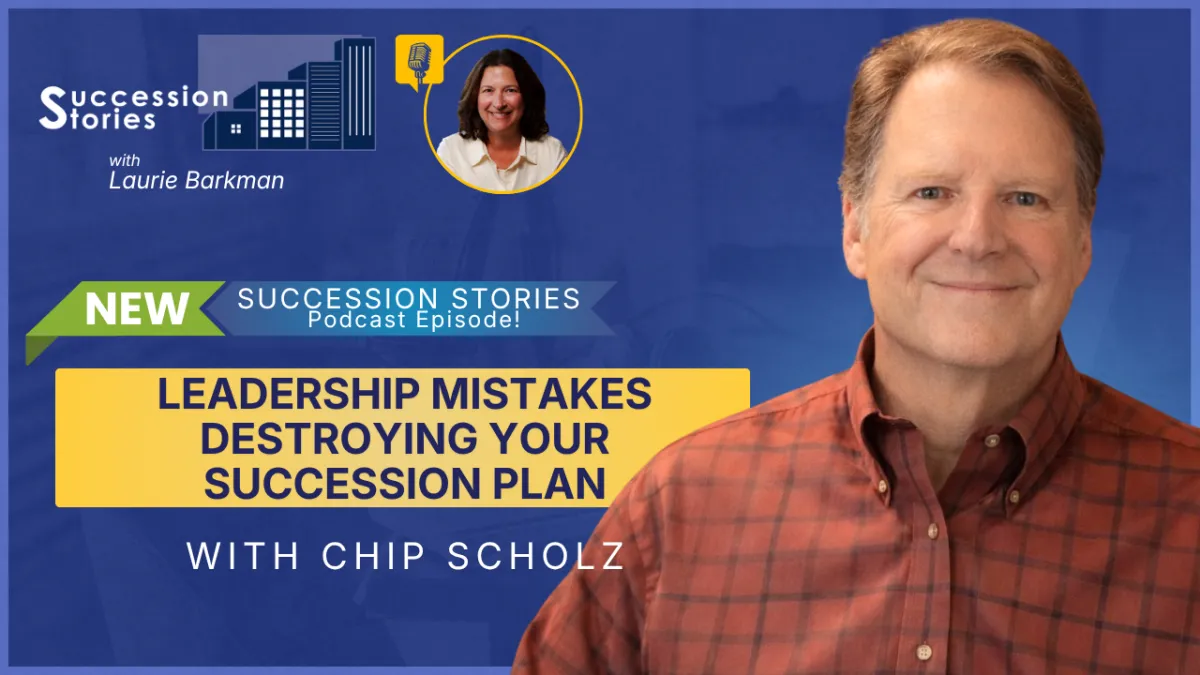
Succession Stories EP231: The Small Decisions That Shape Your Biggest Transitions with Chip Scholz
In this episode of Succession Stories, host Laurie Barkman reunites with Chip Scholz, founder of Scholz and Associates and author of Small Decisions, Big Shifts and the upcoming Handoffs. This conversation is personal — Chip was the executive coach who helped shape Laurie's own CEO journey over a decade ago in a third-generation family business. After nearly 30 years coaching executives and family business leaders, Chip has seen the same hidden leadership mistakes show up again and again — in companies of 10 people and companies of 10,000 — quietly destroying succession plans before founders even realize it's happening.
The Small Decisions That Shape Your Biggest Transitions
What if the way you're holding on to your business right now is quietly limiting what comes next?
In this episode of Succession Stories, I got to do something a little different. I sat down with someone who has shaped the way I think about leadership and succession for more than a decade. Chip Scholz is an executive coach, author, and leadership strategist with nearly 30 years of experience helping leaders navigate change, complexity, and transition.
But this conversation is personal for me. I first met Chip about 13 years ago when I was on the candidate side of a CEO search process for a third generation family business. The assessments, the interviews, the evaluations. It was a gauntlet. And Chip was on the other side of it. Eventually, he became my coach after I stepped into the role. That experience shaped how I think about leadership readiness, succession, and what it really means to build with your end game in mind.
Reconnecting with him for this conversation reminded me why these ideas still matter so much.
What Organizations Get Wrong About Hiring Leaders
We started by going back to where we first met, that CEO search process, and I asked Chip how his thinking has evolved over the years about what organizations should really be looking for when choosing their next leader.
His answer was direct. It comes down to culture. Specifically, whether a leader is people-oriented and performance-driven, in that order.
He also shared a framework he's carried with him ever since that experience, one built around three things:
Strengths
Motivations
Fit
It sounds simple. But he made a point that stuck with me. Nobody gets hired because of their weaknesses. They get hired for their strengths. So why do so many performance conversations end up focused on everything but that?
The Emotional Weight of Family Business Succession
This is where the conversation got real for me.
I've seen it in my own work with clients. The founder who can't step back. The parent who can't hand the baton to the next generation. The senior leader whose presence, even when well-intentioned, starts to become a cultural drag on the very business they built.
Chip has seen it too. Many times over. He talked about the pattern of what he calls getting "scary," where leaders in their 60s and 70s shift from growth-oriented to conservation-oriented. Risk tolerance drops. Delegation disappears. And slowly, without anyone meaning for it to happen, the business stops moving forward.
He also named something I think a lot of founders don't want to hear. Hubris. The quiet belief that you're the only one who can do it, the only one who cares enough, the only one who really understands the business.
One story he shared about a CEO who wouldn't let anyone spend more than $100 without his approval has stayed with me. When that leader finally left, half the team couldn't function without someone to check in with. That's not a leadership legacy. That's a dependency.
The Three Stages Nobody Prepares You For
When I brought up retirement, Chip laid out something I think every business owner needs to hear before they need to hear it.
There are three stages most people move through when they step away from their business:
Vacation
Depression
Meaning and purpose
The first stage feels great. No alarm clock. No one to answer to. Finally, the freedom you've been working toward.
And then it fades.
What comes next, if there's no plan, no identity outside the business, no purpose to replace what the work once gave, can be genuinely dangerous. Chip referenced data suggesting elevated rates of death by suicide among executive white males after retirement. He was careful to note he couldn't cite the exact study, but the finding stayed with him. It stayed with me too.
This is exactly why I try to reach business owners in their 50s, before the exit is imminent, before the surprise offer lands on their desk. The time to think about what comes next is long before you need to.
What I Learned About My Own Identity
There's something I shared in this conversation that I don't always talk about openly.
When I was CEO at the company Chip and I share history with, that's when I started building what I now call a portfolio identity. I knew, even then, that my sense of self couldn't live in one place forever. At some point, every role ends. Every chapter closes. And if everything you are is tied to one title, one company, one business, the transition will find you unprepared.
That perspective has shaped everything I've built since.
Handoffs, and Why It Might Be About Your Family
Chip has a new book coming out called Handoffs, and I cannot wait to read it.
It's a novel, built on decades of real experience inside family businesses. He said something about it that made me laugh and also made me a little unsettled. Every person he's shown it to has asked the same question: did you write this about my family?
That tells you everything you need to know about how universal these dynamics are.
Three Things Every Business Owner Should Take Away
I asked Chip to close with three things he wants business owners to hold onto as they think about transition. Here's what he said:
Know what you don't know. Surround yourself with people who will tell you the truth, including a coach. The smartest leaders in the room are usually the ones who know they aren't the smartest person in the room.
Get a hobby. A real one. Not golf as a placeholder, but something that gives you purpose, community, and a reason to get up in the morning that has nothing to do with your business.
Acknowledge that there is a time. It may not have a date on the calendar yet. But the exit is coming. The leaders who thrive are the ones who make peace with that truth long before it arrives.
A Final Thought
This conversation reminded me why I started this show in the first place.
Transition isn't something that happens to you at the end. It's something you design, or don't, long before it arrives. The small decisions you make today about how you lead, how you delegate, how you build your identity outside the business, those are the things that determine whether your exit feels like a culmination or a loss.
Chip has spent nearly 30 years helping leaders navigate that. And spending time with him again reminded me that the most important succession work isn't legal or financial.
It's personal.
Thirteen years later, Chip is still making me think differently. That's the mark of a great coach and a great conversation. I think you'll feel that too. Listen to the full episode and hear it for yourself.
Is your business truly ready and are you? Take the Succession Readiness Assessment to get a clear snapshot of where you stand and what to focus on next. https://btsherpa.com/succession_assessment
By your side,
Laurie Barkman
Watch the full YouTube Episode here:
Connect with Chip:
LinkedIn: https://www.linkedin.com/in/chipscholz/
Website: https://scholzandassociates.com/
Email: [email protected]