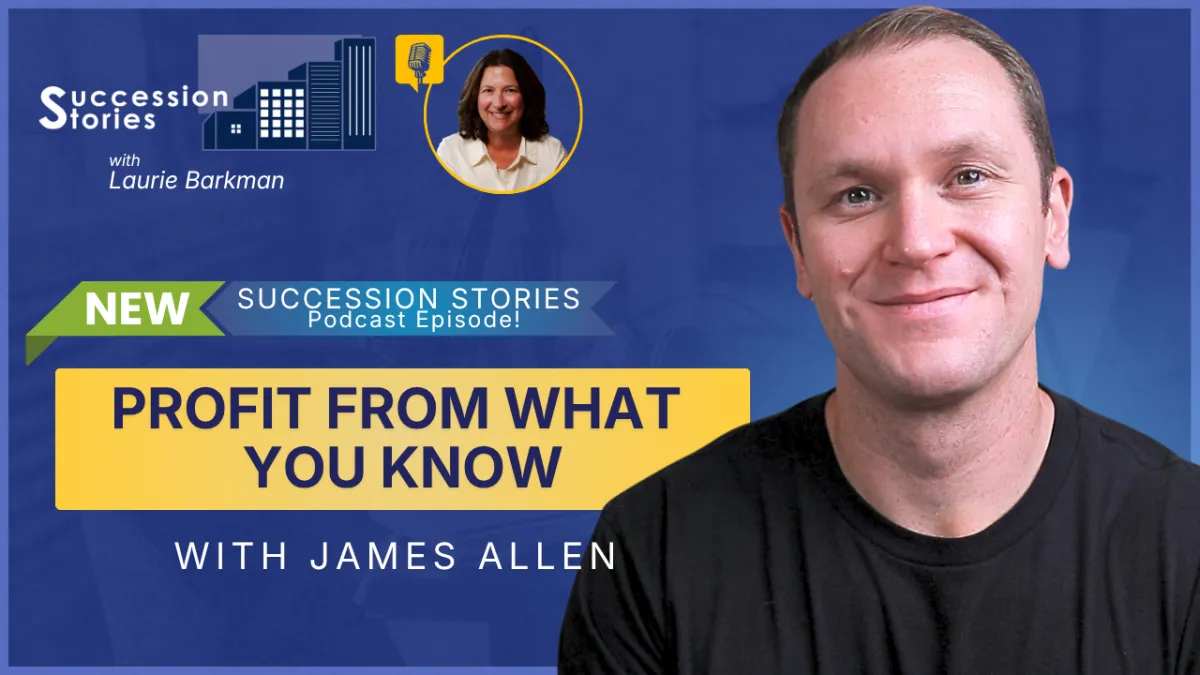
Succession Stories EP229: Profit From What You Know with James Allen, Profit Your Knowledge
James Allen is the founder of Profit Your Knowledge—a platform dedicated to helping creators, coaches, and experts turn their knowledge into scalable, freedom-based online businesses. After leaving a six-figure construction career, James built a thriving digital business that allows him to work less than 20 hours a week while generating six figures in income. (profityourknowledge.com)
Turning What You Know Into What’s Next
Rethinking Business, Freedom, and Succession Through the Lens of Your Expertise
What if the next chapter of your life and your business wasn’t something you had to go out and find, but something you’ve already been building for years?
In this episode of Succession Stories, I sat down with James Allen, founder of Profit Your Knowledge, to explore a powerful and often overlooked idea: your knowledge, what feels “normal” to you, may be your most underutilized asset.
For founders thinking about succession, transition, or simply what comes next, this conversation opens up a different way of seeing what’s possible.
The Hidden Value of What You Already Know
One of the most thought-provoking ideas we discussed is what James calls the expert paradox.
The more experienced you become, the more invisible your own value can feel.
Why? Because repetition creates familiarity. And familiarity creates the illusion that what you do isn’t that special.
But step outside your own perspective for a moment.
What you’ve spent years refining, your instincts, your judgment, your decision-making process, is incredibly difficult for someone else who is just starting out or trying to level up.
That gap between where you are and where someone else wants to be is where opportunity lives.
And often, it’s hiding in plain sight.
Seeing Your Experience Through a Different Lens
The challenge isn’t a lack of value that you can provide. It may be harder to spot your opportunities. . Let’s look at your experience through a different lens.
As a founder, you’ve likely:
Solved problems others are still stuck in
Made decisions under pressure
Built scalable systems
Learned lessons the hard way
Maybe because you’ve lived the experience, it feels routine.
This is where a shift in perspective becomes powerful.
Instead of asking, “What could I possibly offer?”
Start asking, “What do people consistently come to me for?”
That question alone can unlock entirely new directions.
From Operator to Architect of Your Next Chapter
As an entrepreneur, you might feel that your succession is an endpoint.
Exit = Sell the business. Step away. Slow down.
But what if it’s not an ending at all?
What if it’s a transition from being the operator of a business -> to becoming the architect of a more intentional life for yourself?
Consider a path that doesn’t require you to disconnect from your experience. It invites you to reimagine how you use it.
Instead of managing teams, operations, and day-to-day demands, you can shift into:
Sharing insight instead of overseeing execution
Guiding others instead of carrying the full weight yourself
Creating value through perspective, not just production
It’s a different kind of leverage.
For many founders, considering what’s next, it’s about seeking something more enjoyable, fulfilling, and rewarding personally.
The Shift From Effort to Leverage
As a business owner, you know the effort it takes to drive results.
Long hours. High stakes. Constant responsibility.
Even at high levels of success, the business often depends heavily on you.
What we explored in this episode is a different model, one centered on leverage.
Leverage of:
Your experience
Your thinking
Your frameworks
Your ability to simplify complexity for others
Instead of asking, “How do I do more?”
The question becomes, “How can what I already know create more impact?”
That shift changes everything.
Building Something That Supports Your Life
One of the most compelling parts of this conversation is the idea that your business doesn’t have to consume your life. It can be designed to support it.
For founders who have spent years building something demanding, this can be a refreshing perspective.
Imagine a business that:
Doesn’t require 50 to 60-hour workweeks
Gives you control over your time
Allows you to choose who you work with
Still generates meaningful income
That kind of business doesn’t happen by accident. It comes from being intentional about what you build and why.
Finding Your Income Intersection
To bring this idea down to something practical, James shared a simple but powerful framework.
Your best opportunity tends to sit at the intersection of three things:
You have real, lived experience.
There is a clear demand for it
You genuinely enjoy engaging with it
Miss one of these, and things get harder.
Hit all three, and you create something that not only works but lasts.
It’s not about chasing trends.
It’s about aligning what you know with what matters to you and what others need.
Why This Matters for Succession Planning
This conversation isn’t just about building something new. It is about making better decisions about what you already have.
One of the biggest challenges I see with founders is hesitation around transition.
Not because they’re unprepared financially or operationally, but because they’re unclear about what comes next.
Without that clarity:
It’s harder to step away
It’s easier to delay decisions
The idea of succession feels uncertain
But when you begin to shape a vision for your next chapter, something shifts.
You move from reacting to designing.
And that makes all the difference.
Designing Freedom on Your Terms
There’s a common belief that freedom comes after success.
But what stood out to me in this conversation with James is that freedom is often the result of how you define success in the first place.
If your next chapter is built intentionally, it can reflect:
The pace you want
The work you enjoy
The impact you care about
The life you want to live
That’s a very different outcome than simply stepping away without a plan.
A Final Thought
At some point, every entrepreneur faces a transition.
The question is not when will your business transition occur?
The question is how will you feel when it does?
Excited for what’s next. Or uncertain and concerned.
What can you start doing NOW to help you feel ready and design the life you want after the “exit”?
Your next chapter may not require you to start from scratch. Recognize that what you already know may be more valuable and more transferable than you think. And use this knowledge to help design your NEXT.
This conversation addresses paradigms that may challenge how you think about what comes next.
These are the kinds of conversations I come back to often, especially when thinking about what comes next.
Sign-up for my newsletter, to get more reflections, ideas, and insights that build on succession topics like this. https://lauriebarkman.me/newsletter
By your side,
Laurie
Watch the full YouTube Episode here:
Connect with James Allen:
Website: profityourknowledge.com
YouTube: @ProfitYourKnowledge
Email: [email protected]