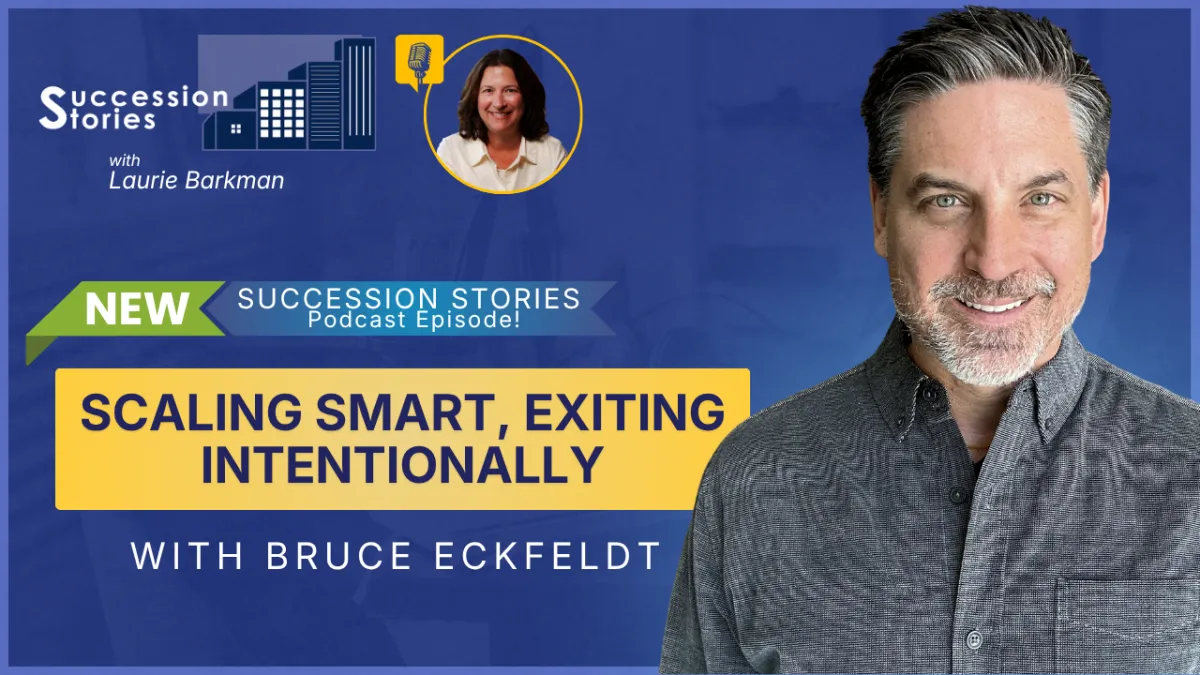
Succession Stories EP228: Scaling Smart, Exiting Intentionally with Bruce Eckfeldt
Bruce Eckfeldt, a former Inc. 500 CEO who scaled, led, and exited — and now helps founder-CEOs do the same with intention. He’s a certified Scaling Up and Metronomics Coach, a Certified Exit Planning Advisor, an Inc. Magazine contributor, and host of the From Angel to Exit podcast.
The Exit You Want Starts Long Before You’re Ready
Most founders think about exit as a finish line.
Something distant. Something future.
Something they’ll “figure out later.”
But what if that mindset is exactly what’s holding you back from scaling faster, building real value, and ultimately creating the freedom you say you want?
In a recent episode of Succession Stories, I sat down with Bruce Eckfeldt, former Inc. 500 CEO turned scaling and exit strategist, to unpack a truth many founders avoid:
Exit isn’t the end of the journey. It’s the lens that should shape the entire journey.
The Accidental Founder Trap
Bruce didn’t set out to be a CEO.
He started as an architect, moved into tech, and found himself building what began as “just a project”… until it wasn’t.
Sound familiar?
Many founders don’t start with a grand vision of building a company, they grow into it. And along the way, they get pulled into operations, growth, and opportunity.
But here’s the catch:
If you don’t intentionally design the business, it will design you.
And often, that design leads to a place where:
You are the business
You drive the revenue
You hold the knowledge
You carry the pressure
That’s not a scalable company. That’s a dependency.
Why Growth Without Exit Strategy Is Dangerous
One of the biggest misconceptions founders have is that scaling and exiting are separate phases.
They’re not.
Bruce made it clear:
When founders define what they want after the business, they grow faster inside the business.
Why?
Because clarity creates urgency.
When you know:
What you want your life to look like
When you want to transition
What resources you’ll need
…you start making sharper decisions:
What kind of company to build
What kind of team to develop
What kind of buyers to attract
Without that clarity?
You drift.
The Real Risk: Founder Dependency
If there’s one silent value killer in businesses, it’s this:
The company cannot function without the founder.
Bruce sees it all the time, and it shows up in two major ways:
The Founder as Rainmaker
You close the deals. You own the relationships. You drive revenue.
It feels powerful, but it’s fragile.
And here’s the hard truth: Buyers don’t pay a premium for businesses that walk out the door when you do.The Founder as the “Smartest Person in the Room”
You are the product. The expertise. The intellectual engine.
And you might actually be irreplaceable.
But that creates a ceiling.
Because:
You can’t scale what only exists in your head
You can’t sell what isn’t transferable
At some point, you have to make a choice: Stay essential… or build something that survives without you.
Optionality Is the Real Goal
Many business owners think they’re stuck.
“This is just how my business is.”
But that’s rarely true.
What’s actually missing is intentional planning.
Bruce introduced a powerful idea:
The “keep-sell” posture.
Build your business so you can:
Sell it tomorrow
Or keep it for 10 more years
That’s optionality.
And optionality gives you:
Leverage in negotiations
Freedom in decisions
Control over your future
Without it, you’re reacting, not leading.
The Exit No One Plans For
Here’s where it gets uncomfortable.
Many founders spend years preparing their business for exit…
But almost no time preparing themselves.
Bruce shared one of his biggest lessons:
“I knew I wanted to exit. I just didn’t know what I wanted to do next.”
And that gap?
It creates hesitation. Delay. Sometimes even regret.
Because when the business is your identity, stepping away isn’t just a transaction, it’s a transformation.
What Actually Drives Value
If you want to build a business that commands a premium, not a discount, focus here:
✔ Strategic Positioning: Are you differentiated, or competing on price?
✔ Leadership Depth: Can the business run and grow without you?
✔ Systemized Knowledge: Is expertise embedded in the company, or trapped in individuals?
Because at the end of the day, the more your business depends on you, the less valuable it becomes.
A Better Way to Think About Exit
Exit planning isn’t about leaving.
It’s about building better.
A better business
A better life
A better set of options
And the earlier you start, the more control you have.
This is just a glimpse into a powerful discussion on scaling, founder dependency, and building a business that truly works for you.
By your side,
Laurie
Watch the full YouTube Episode here:
Connect with Bruce:
LinkedIn: http://www.linkedin.com/in/beckfeldt
Website: http://www.eckfeldt.com