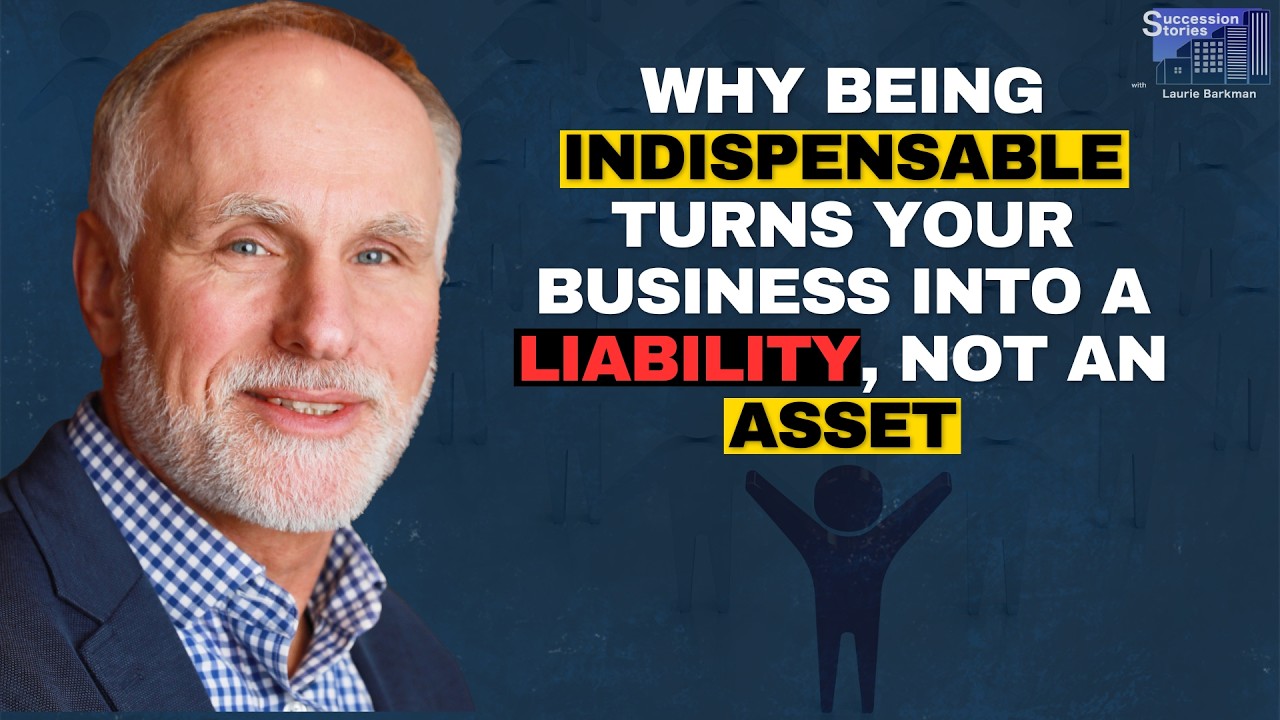
Succession Stories EP226: Building Value Beyond the Founder: The Structural Capital Advantage, Steve Preda
Steve Preda’s passion is to help entrepreneurs build great businesses. He has helped more than 250 businesses become more valuable and buyable as an investment banker, management consultant and business coach. He built, scaled and sold his own business in Hungary, before moving to America and has written three books about his experiences, including Buyable: Your Guide to Building a Self-Managing, Fast-Growing, and High-Profit Business. He lives in Virginia.
The Founder Identity Trap: Building a Business That Can Thrive Without You
Many founders say they want freedom.
More time. Less stress. A business that runs smoothly without them having to be involved in every decision.
But here’s the paradox I see all the time: entrepreneurs often build companies that depend entirely on them.
In this episode of Succession Stories, I sat down with Steve Preda, coach, strategist, and founder of Summit OS, to talk about why that happens and how founders can break free from what I call the founder identity trap.
Steve has spent years helping growth-minded entrepreneurs systematize their companies, develop stronger leadership teams, and create businesses that can thrive with or without the founder. Our conversation explored the mindset shifts and practical structures required to move from a founder-dependent company to one that’s truly transferable.
And as we discussed, this transformation starts with a simple but uncomfortable realization: being indispensable eventually becomes the biggest barrier to growth.
The Founder Identity Trap
One of the biggest tensions founders face is this: they start businesses to gain independence, but over time, the business begins to control them.
Steve explained that many entrepreneurs launch companies because they want autonomy, creative freedom, or the ability to shape their own path. The business becomes the vehicle that fulfills those needs.
But when the company grows, and it becomes time to step back, or even think about stepping back, that can feel threatening.
The business is no longer just a company. It’s tied to the founder’s identity.
And that’s where things get complicated.
When Being Indispensable Becomes a Bottleneck
Early in a company’s life, the founder doing everything often feels like a strength.
You’re making the decisions. You know the customers. You understand the product better than anyone else.
But as the company grows, that same dynamic can become a constraint.
There’s only so much one person can handle. Even founders who delegate well often keep final decision-making authority. Over time, that creates a bottleneck.
It also makes it harder to attract top-tier leaders. High-performing executives want responsibility and autonomy. If every decision flows back to the founder, those leaders won’t stay long.
At some point, if a business is going to scale, the founder has to begin letting go.
Profitability Isn’t the Same as Transferability
One distinction I emphasize often, and Steve reinforced during our conversation, is the difference between a profitable business and a transferable one.
Profitability is essential. Buyers want to see strong margins and consistent financial performance.
But that alone isn’t enough.
A transferable business operates like a system. It produces results because the organization works, not because one extraordinary founder holds everything together.
Steve shared an example of a founder-led company generating around $30 million in revenue with extremely strong margins. The founder made most of the decisions and drove much of the success personally.
After the business was sold, the buyer had to hire three executives to replace him, and even then, the company struggled to maintain the same performance.
The lesson is clear: if the business depends entirely on the founder’s abilities, its value becomes fragile.
Building Structural Capital
So how do founders start reducing that dependency?
Steve’s approach focuses on building structural capital—the systems, processes, and operating discipline that allow a company to function consistently.
The first step isn’t documenting processes. It is alignment.
Leadership teams need:
A clear vision
A strong strategic plan
Execution discipline
A consistent operating cadence supported by KPIs
Once those fundamentals are in place, companies can begin systematically delegating and documenting key functions.
Interestingly, Steve often starts by systematizing leadership-level responsibilities first. When leadership teams free up their time from operational tasks, they can spend more energy working on the future of the business.
As Steve put it, companies must balance two priorities simultaneously:
Delivering results in the present
Building capacity for the future
It’s both harvesting and investing at the same time.
Systematization Isn’t Just for Big Companies
Some founders assume systematizing operations is something only large companies can afford.
But in reality, smaller companies often have more flexibility to implement systems quickly.
One of the biggest misconceptions Steve sees is that teams are already operating at full capacity. In most organizations, employees actually have untapped potential and are eager to take on more responsibility if given the right structure.
Technology has also changed the equation dramatically.
With AI and modern tools, founders can now:
Create SOPs quickly
Transcribe processes into documentation
Delegate work to virtual assistants around the world
Automate workflows that once required entire departments
One practical tip I shared during the conversation: whenever possible, document processes in text form. Written documentation can easily be used by AI tools for training, refinement, and automation.
Constraints Can Spark Innovation
Another theme that came up during our discussion was resource constraints.
Many entrepreneurs feel like they’re constantly building the plane while flying it. Cash flow is tight, decisions are urgent, and growth can feel chaotic.
But constraints can actually drive creativity.
Steve used the story of IKEA founder Ingvar Kamprad as an example. Growing up in rural Sweden, Kamprad started by selling simple products through mail order. Over time, through innovative thinking and operational discipline, that small venture became one of the most dominant furniture retailers in the world.
Limited resources often force founders to focus on what truly moves the needle.
Begin With the End in Mind
One of the most powerful ideas we discussed is something I talk about frequently with founders: reverse engineering your exit.
Many business owners say they aren’t ready to think about succession or transition yet.
But every founder will transition eventually.
The real question is whether that transition will be intentional.
When founders take time to clarify their long-term goals—whether that’s creating a lifestyle business, building a saleable asset, or leaving a legacy—they can make better strategic decisions today.
Clarity about the end goal informs everything from growth strategy to leadership development.
The Real Goal: Freedom and Optionality
At the heart of this conversation is a simple truth: a transferable business creates options.
When your company no longer depends entirely on you, something powerful happens. You gain flexibility.
You can scale the business further. You can step into a strategic role. You can bring in professional leadership. Or you can pursue a transition when the time is right.
In other words, the goal isn’t just preparing for an eventual exit. It’s building a business that creates freedom, resilience, and long-term value along the way.
And that’s ultimately what succession planning is all about.
If you’re building a company and thinking about long-term value, scalability, and eventual transition, this is a conversation you won’t want to miss.
By your side,
Laurie
Watch the full YouTube Episode here:
Connect with Steve:
Website: https://stevepreda.com
LinkedIn: https://www.linkedin.com/in/stevepreda/
This Show Is Sponsored by The Business Transition Sherpa®
Learn what every entrepreneur needs to know about building value and avoiding pitfalls!
📖 Get your FREE digital copy of The Business Transition Handbook:
https://lauriebarkman.me/book
📣 Write a Podcast Review: ratethispodcast.com/successionstories