From “How I Use AI” to “How We Use AI”: Where Enterprise Value Comes From
What processes would you build if you weren’t constrained by how your business works today?
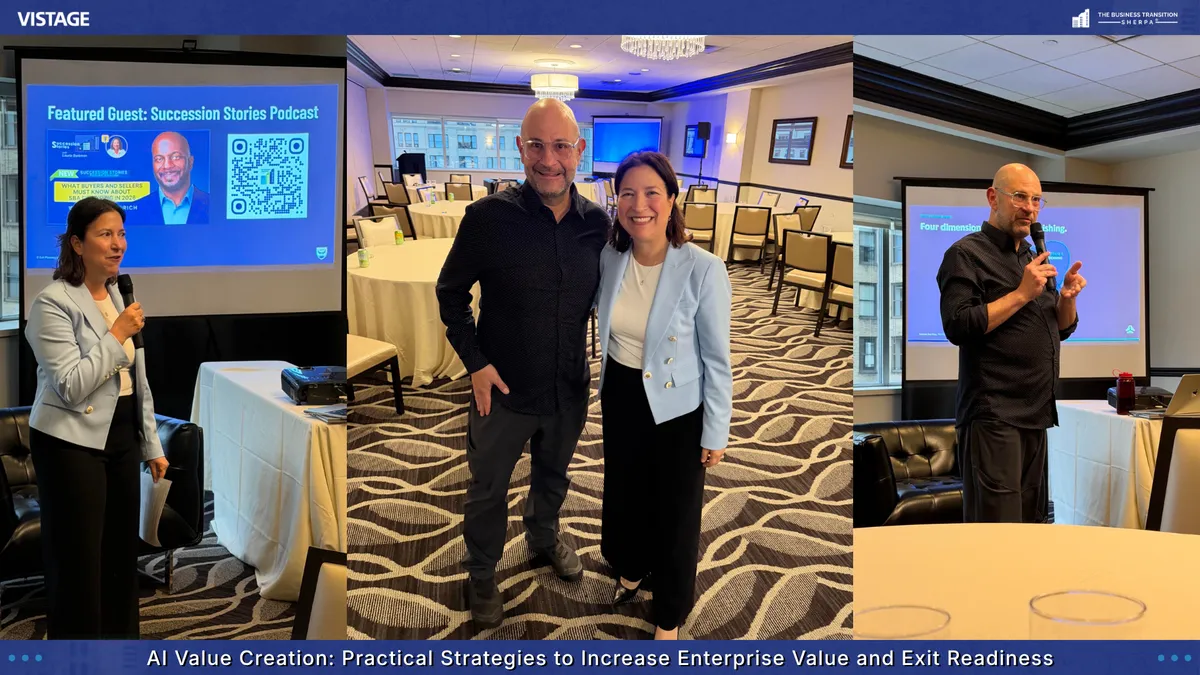
That’s a question I’ve been thinking about following Michael Hruska’s presentation at our Exit Planning Institute Pittsburgh Chapter event.
Michael Hruska, CEO of Problem Solutions and co-founder of Baryons, led a thoughtful conversation about AI value creation. I appreciated the opportunity to explore his ideas further during our fireside chat and hear the questions from the room.
Thank you, Michael, for sharing your perspective, and thank you to everyone who joined us.
One idea from the session has stayed with me: AI has accelerated the work, but the human systems around it haven’t necessarily caught up.
An individual can produce more research, analysis, and drafts in less time. But what happens next? Who reviews the work? How are decisions made? Can the team turn that additional output into meaningful progress?
Those questions point to an opportunity that goes well beyond individual productivity.
Rethinking how work gets done
Many business processes reflect the constraints under which they were created. Information was difficult to gather. Analysis took days. Expertise sat with a few people. Work moved from one department to another because that was the practical way to get it done.
With AI, some of those constraints are changing. That gives leaders a reason to revisit the process itself.
If you were building this workflow today, would you design it the same way? Would it require the same steps, handoffs, and approvals? Where could people contribute more judgment and spend less time preparing information for someone else?
Michael’s presentation encouraged us to consider what becomes possible when we look beyond the way we’ve always worked.
For business owners, that’s a valuable place to start. Before adding AI to an existing process, ask what outcome you need and how the work could be designed to achieve it.
From “How I use AI” to “How we use AI”
Michael challenged us to think about the shift from personal AI use to organizational capability.
An individual may find an effective way to use AI. Turning that success into something a team can rely on requires shared context, clear standards, and agreement about how the work gets done.
If your best AI work lives in one person’s chat history, what happens when that person leaves? Can someone else use it, evaluate it, and improve it?
This is where I see a direct connection to enterprise value and transition readiness.
A business becomes more transferable when its capabilities can be understood and sustained by others. Documented workflows, reusable tools, and clear accountability give the next leadership team something to build on. They also help a buyer understand how the business operates and whether its performance can continue.
The opportunity is to make AI part of how the organization works, with processes that can evolve as its capabilities grow.
Keeping human judgment at the center
Michael offered a helpful progression for how we engage with AI: toy, tool, teammate.
We begin with curiosity and experimentation. We find practical applications. Then we learn to work with AI more thoughtfully, providing context, questioning its responses, and refining the result.
His suggested workflow keeps people involved throughout: a human frames the problem, AI helps generate the work, and a human evaluates it. Further refinement follows before a person takes responsibility for the final output.
That resonates with me as an advisor. Business decisions require an understanding of people, priorities, and consequences. Faster analysis can inform those decisions, while leaders remain responsible for the call.
Michael also discussed the movement from knowledge work toward work that requires greater understanding and wisdom. As AI handles more information processing, leaders have an opportunity to devote more attention to what matters, why it matters, and what to do next.
Building the organization to keep pace
Michael reminded us that AI literacy goes beyond prompting. It includes technical understanding, ethical judgment, and the relational skills that help people work together.
That last piece deserves attention.
A redesigned process may change responsibilities, decision-making authority, or the way teams collaborate. People need to understand those changes and have a voice in making them work.
The session also explored stages of AI adoption and organizational maturity. My takeaway was to be honest about where your business stands and choose a practical next step.
Which use case deserves a pilot? What would success look like? What needs to change in the surrounding workflow? Who will own the process as it develops?
Those questions help connect experimentation to business results.
What this means for growth and transition
In my work with owners, growth planning and transition planning are closely connected. Both require us to consider what the business needs to become and which capabilities will help it get there.
AI belongs in that conversation.
It can prompt us to reconsider longstanding assumptions about capacity, expertise, and how work moves through the business. It can also help us identify where leadership, coordination, or decision-making needs to improve.
Three questions worth considering:
Which processes are still shaped by limitations that AI may now help us overcome?
If we designed those processes today, what would we change about the steps, roles, and decisions involved?
How will we turn what we learn into capabilities the business can sustain and improve?
Creating lasting value takes more than access to new technology. It takes leaders willing to rethink how the business works and help their people build what comes next.
What process in your business would you redesign if you weren’t constrained by how it works today?
By your side,
Laurie.
Connect with Michael Hruska:
Websites:
LinkedIn: https://www.linkedin.com/in/mikehruska/