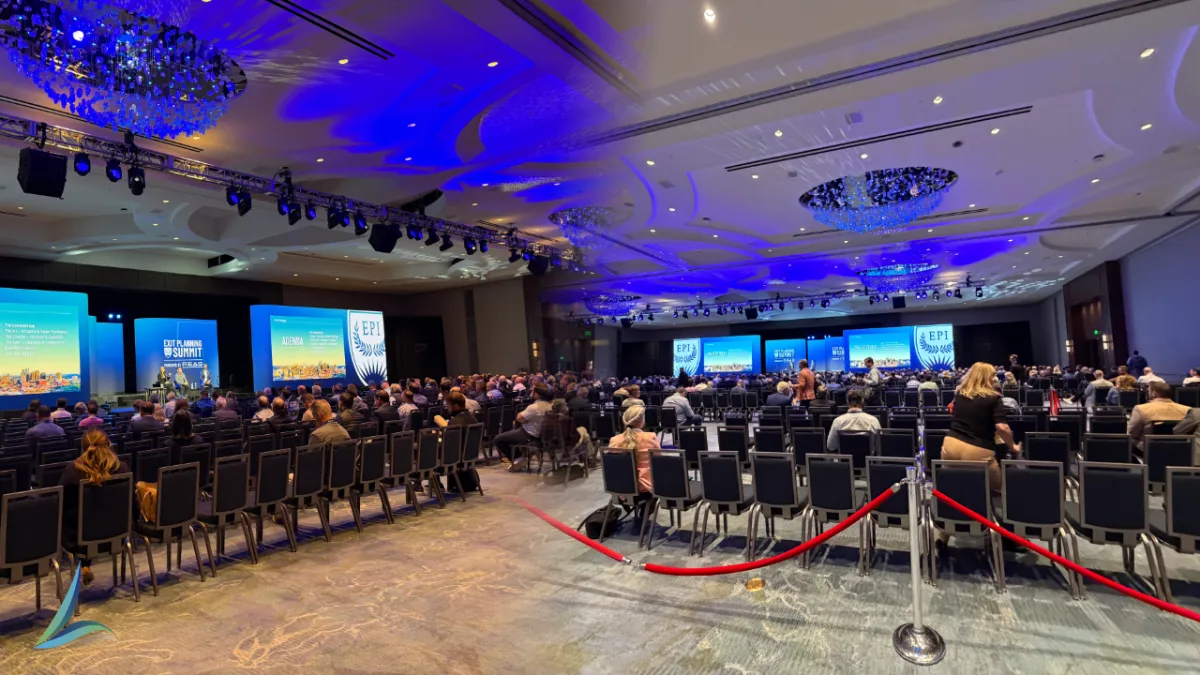
Recap: Exit Planning Summit in Nashville, From Insight to Activation
Spending several days in Nashville at the Exit Planning Summit surfaced a consistent pattern across almost every session, hallway conversation, and roundtable discussion. The technical side of exit planning matters, but execution and behavior matter more.
What stood out most was not a single framework or model, but a repeated reality check about how businesses are actually built, and how they are ultimately valued.
Owner Dependency and Business Value
A theme that surfaced early and never really left the conversation was this:
When a business is overly dependent on its owner, it carries more risk in the eyes of a buyer, and that risk directly impacts valuation.
This is not a reflection of a lack of capability. In many cases, it is the opposite. Owners are often the driving force behind the business, leading sales, holding key relationships, making critical decisions, and stepping in wherever needed to keep things moving forward.
The challenge is that what makes a business successful day to day is not always what makes it transferable or attractive in a transaction.
From a buyer’s perspective, dependency equals uncertainty. If the owner stepped away tomorrow, what would actually remain? Would revenue continue? Would clients stay? Would decisions still get made at the same pace and quality?
The more those answers depend on “the owner is involved,” the more risk gets priced into the deal.
This is where a gap often forms between expectation and reality. Owners see the value of what they have built, but buyers see the concentration of risk tied to one person.
From Insight to Activation
A central message that tied many of the sessions together came from Scott Snider, President of the Exit Planning Institute. One word kept coming up: activate
It is a simple word, but it carries weight in this context.
A lot of advisors, owners, and professionals understand what needs to be done. The gap is not knowledge. The gap is execution.
Activation means moving from understanding concepts to actually implementing them inside the business in a way that changes outcomes.
That shift was framed as the real work of exit planning. Not just designing strategies, but helping owners take action on them in a meaningful and consistent way.
How Value Is Actually Built
Across conversations with entrepreneurs, M&A advisors, personal wealth advisors, tax attorneys, and valuation experts, there was strong alignment on one point:
Value is built intentionally, not passively.
Businesses that command stronger valuations tend to share a few characteristics:
Systems that allow the business to run without constant owner involvement
Predictable and repeatable revenue streams that give buyers confidence in future performance, not just historical results
Decision-making that is guided by long-term outcomes, not just short-term results
A leadership team that can operate independently, make decisions, and sustain performance without constant oversight
Financials that are clean, organized, and easy for outsiders to understand
What ties all of these together is clarity and transferability. The more a business can demonstrate that it operates as a system rather than as an extension of one person, the more confidence it creates for a potential buyer.
The Personal Side of Exit Planning
One of the most important reminders from the summit was that exit planning is not purely financial. It is deeply personal.
This came through strongly in discussions around what happens after the business is sold or transitioned.
The questions shift from valuation and structure to identity and direction:
What does life look like after you leave the business?
What are you stepping into next?
What replaces the role, purpose, and rhythm the business provided for you?
These are not secondary questions. They often influence decisions long before a transaction ever occurs.
When you do not have clarity on what comes next, it can quietly affect timing, deal structure, and even willingness to act at all.
Culture as a Value Driver
Another standout perspective came from Ben Utecht, who spoke about building culture with intention rather than allowing it to form by default.
That idea resonated because culture is often discussed but not always actively designed.
In practice, culture shows up in:
How decisions are made
How teams communicate
What behaviors are rewarded or tolerated
How aligned the organization actually is
Buyers notice this quickly. Even if it is not explicitly stated, misalignment creates friction. It introduces hesitation and questions about scalability and continuity.
On the other hand, clear and consistent culture builds trust. It signals stability beyond any single individual.
Culture is not a statement or a set of values on a wall. It is what the business actually does every day.
Why Activation Matters in Practice
The idea of activation showed up again here as well.
Culture is not something that exists because it is written down. It exists because it is reinforced through behavior, decisions, and accountability.
The same is true for exit readiness.
A business is not made transferable by intention alone. It becomes transferable through repeated actions that reduce dependency, clarify structure, and improve consistency over time.
One of the most valuable parts of the experience was simply being in conversations with people who are deeply committed to this work.
There was a shared sense that everyone is trying to improve outcomes for business owners, but also a recognition that good intentions alone are not enough.
Many discussions circled back to the same tension. There is no shortage of information in this space. The challenge is turning that information into structured action that actually changes how businesses operate.
That is where progress really happens.
Parting Thoughts
This has been my theme.. Less theory, more doing. Less someday, more let’s figure this out now.
The conversations, frameworks, and perspectives all pointed in the same direction. The value of a business is not just defined by what it earns today, but by how well it can operate without its owner, and how intentionally it has been built to move forward without them.